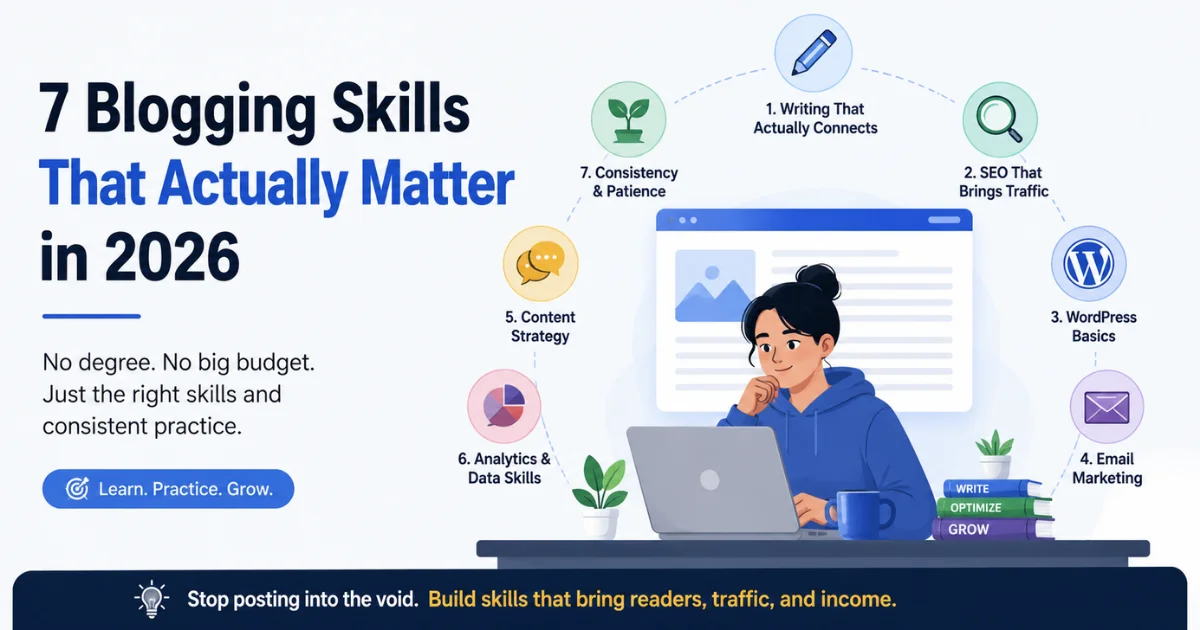
Honestly, I wasted about eight months writing blog posts that nobody read.
Not because I couldn’t write. I could. But I had no idea about SEO, I didn’t know how to structure content for actual humans, and I definitely didn’t know how to turn any of that into money. I was just… posting into the void and hoping someone would show up.

If that sounds familiar, you’re not alone. A lot of beginners go through that exact phase. The good news? You don’t need a degree, a big budget, or even a ton of time to build real blogging skills. You just need to learn the right things — and actually practice them.
Here’s what actually matters in 2026.
Writing That Actually Connects — Not Just “Good Grammar”

Here’s what nobody tells you at the start: you don’t need to write like a journalist. You need to write like a friend explaining something useful.
The blogs that get shared, bookmarked, and commented on? They’re written by people who sound like real humans. Short sentences. Stories. Opinions.
When I started writing like I was texting a friend instead of filing a report, my time-on-page doubled within three weeks. Same topics, completely different tone.
How to build this skill:
- Read blogs in your niche obsessively — not to copy, but to notice what feels good to read
- Write every single day, even if it’s just 200 words in a notes app
- Read your posts out loud before publishing — if it sounds stiff, rewrite it
- Study great writers like Paul Graham or James Clear just to absorb their rhythm
Tools that help: Hemingway App (free) for readability, Google Docs for drafting, and Grammarly for quick checks — but don’t let Grammarly make you sound robotic.
Search Engine Optimization (SEO) — The Skill That Makes Everything Work
I know, I know — “learn SEO” is the most boring advice in the blogging world. But hear me out, because most beginners learn it the wrong way.
They stuff keywords everywhere and wonder why Google ignores them. Or they go too deep into technical SEO before they’ve published more than five posts.
What actually works for beginners:
1. Learn keyword research first. Before writing anything, check if people are actually searching for it. Use free tools like Google Search Console, Ubersuggest (free plan), or just the autocomplete in Google itself.
2. Understand search intent. If someone searches “best budget laptops,” they want a list with prices — not a history of laptops. Match your content to what people actually want.
3. Write proper titles and meta descriptions. Your title is what shows up in search results. It should be clear, specific, and a little bit clickable. No tricks, just accuracy.
4. Build internal links. Once you have a few posts, link between them. It helps Google understand your site and keeps readers on your blog longer.
I used to ignore SEO for months. My breakthrough came when I wrote one post specifically targeting a low-competition keyword — a question I found people asking in Reddit threads. That post brought in 3,000 visitors in its second month. Same writing ability, just smarter targeting.
Free tools worth using: Google Search Console, Ahrefs Webmaster Tools (free version), and the Keywords Everywhere Chrome extension.
Basic WordPress Skills (Or Whatever Platform You Use)
You don’t need to be a developer. But you do need to not be afraid of your own website.
A huge mistake beginners make is spending more time messing with themes and plugins than actually publishing content. I’ve done this. You’ll spend a Sunday “fixing” your site and realize you haven’t written a word.
The basics you actually need:
- How to publish and format a post
- How to install and manage plugins (don’t go overboard — 5 solid plugins are better than 25)
- How to set up a sitemap and connect Google Search Console
- How to make your site load fast (use a caching plugin like WP Rocket or the free LiteSpeed Cache)
- Basic image optimization before uploading (TinyPNG is free)
If you’re not on WordPress, the same logic applies to Blogger, Ghost, or even Substack — learn the platform well enough that it doesn’t slow you down.
READ MORE: How to Start a Blog and Make Money From It
Email Marketing — The Asset You Actually Own
Social media can disappear. Google can change its algorithm. But your email list? That’s yours.
This took me way too long to take seriously. I spent over a year building traffic before I even thought about collecting emails. By the time I set up ConvertKit (now called Kit), I already had posts with thousands of pageviews and nothing to show for it.
Don’t make that mistake. Set up a simple email opt-in form before you even hit 100 monthly visitors.
What to learn:
- How to create a basic opt-in form and connect it to your blog
- How to write a welcome email that actually gets opened
- How to send a simple newsletter — weekly or bi-weekly is fine to start
- How to segment your list later as it grows
Free tools to start: Kit (formerly ConvertKit) has a solid free plan. Mailchimp works too if you’re already familiar with it.
The goal isn’t to become an email marketing guru. The goal is to have a way to bring your readers back without depending on Google every time.
Content Planning & Consistency
This is the skill nobody talks about but almost everyone struggles with.
Posting randomly doesn’t work. Neither does burning yourself out trying to post every day. What works is having a realistic, sustainable system.
When I started planning just one month ahead — knowing what I’d write and roughly when — everything got easier. Less decision fatigue. Less staring at a blank screen.
A simple system that works:
- Pick 8-10 topics each month based on keyword research
- Write 3-4 posts per week (even short ones count)
- Batch your research and outline phase on one day, writing on another
- Use a simple Google Sheet or Notion board to track what’s published, what’s in draft, what’s coming
You don’t need fancy project management tools. A basic spreadsheet is honestly enough to start.
Monetization Skills — The Part Everyone Rushes
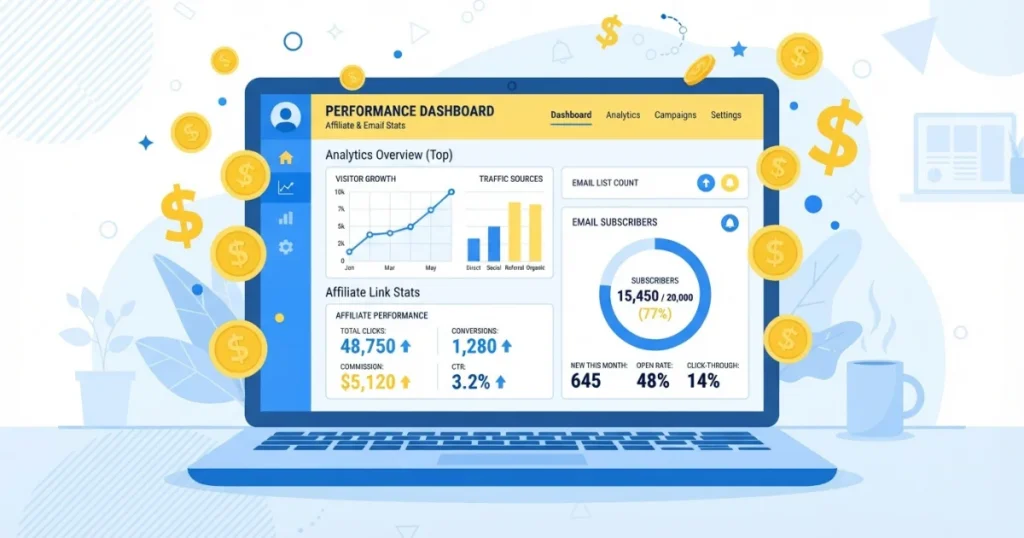
Here’s the mistake almost every new blogger makes: they sign up for Google AdSense on day one and wonder why they’re making $0.03 per day.
Ads don’t work until you have traffic. And traffic takes time. So focus on building the audience first — then monetize smartly.
The income streams that actually work for bloggers in 2026:
Google AdSense / Mediavine / Raptive: Great passive income once you have 10,000+ monthly sessions. For beginners, AdSense works but pays less. Mediavine requires 50k sessions but pays significantly more.
Affiliate Marketing: You recommend a product, someone buys it through your link, you earn a commission. This is often the fastest path to real money for bloggers. Amazon Associates is easy to start with, but niche affiliate programs usually pay better.
Digital Products: Once you have an audience, selling a simple PDF guide or email course can make more per sale than any ad network. Tools like Gumroad make this surprisingly simple.
Sponsored Posts: Brands pay bloggers to write about their products. This becomes realistic once you have a decent monthly traffic number or a niche with engaged readers.
The skill here isn’t just knowing these exist — it’s understanding when to use each one and how to integrate it without annoying your readers.
Basic Analytics Reading
You don’t need a data science degree. But you do need to understand what’s working and what isn’t.
Google Analytics 4 (GA4) is free and gives you everything you need to start. Focus on:
- Which posts get the most traffic
- Where your traffic comes from (search, social, direct)
- How long people stay on your posts
- Which posts have the highest bounce rate (that’s a sign something’s off)
Once I started checking analytics weekly — not obsessively, just a quick 15-minute review — I stopped guessing. I knew which topics resonated, which formats people preferred, and where to focus next.
Common Mistakes Beginners Make (And How to Avoid Them)
Mistake 1: Waiting until the blog “looks perfect” to publish. Design matters, but publish ugly and improve later. Content brings traffic, not pretty fonts.
Mistake 2: Writing for search engines first, humans second. Robots don’t share your posts. People do.
Mistake 3: Trying to learn everything at once. Pick two or three skills from this list and go deep. Master those before adding more.
Mistake 4: Comparing yourself to bloggers with 5 years of experience. Their overnight success usually took three years of unsexy consistency.
Mistake 5: Never building an email list. The biggest regret of almost every blogger who makes it.
Where to Actually Learn These Skills (Without Paying a Fortune)
You don’t need expensive courses to learn any of this. Here’s where I’d start:
- YouTube — Channels like Income School, Niche Pursuits, and Adam Enfroy’s content are legitimately useful
- Google’s free resources — Google Search Central blog, GA4 tutorials, and Google’s own SEO starter guide
- Blogging communities — Reddit’s r/blogging and r/juststart are brutally honest and genuinely helpful
- Neil Patel’s blog — Dense but solid on SEO fundamentals
- Kit’s free email marketing resources — Their guides are beginner-friendly and non-salesy
Practice beats theory every time. Read a little, try it, fail, adjust, repeat.
The Honest Timeline You Should Expect
Month 1-3: Setting up, writing, feeling like nobody is reading (because almost nobody is)
Month 4-6: First trickle of organic traffic, first few email subscribers, maybe your first affiliate click
Month 6-12: Things start compounding if you’ve been consistent. Some posts start ranking. Traffic becomes more predictable.
Month 12+: Real income becomes realistic if you’ve been strategic — not necessarily “quit your job” money yet, but real money.
This isn’t a get-rich-quick thing. Never was, never will be. But it’s one of the few online income paths where the effort you put in genuinely compounds over time.

READ MORE: AdSense Approval Tips for New Bloggers (Guide to Get Approved Fast)
Final Thoughts
If you’re starting from zero right now, don’t let the list overwhelm you. You don’t need to master all of this before you publish your first post.
Start with writing and basic SEO. Build the habit of showing up consistently. Add skills as you go.
The bloggers who make real money aren’t necessarily the most talented. They’re usually the ones who didn’t quit in month four when things felt pointless.
Pick one skill from this list. Go learn it. Then come back for the next one.
That’s genuinely how it works.
Frequently Asked Questions
1. How long does it take to make money from blogging?
Realistically, most bloggers start seeing meaningful income between 6 and 18 months, depending on how consistently they post and how well they apply SEO and monetization strategies. Some niches are faster than others.
2. Do I need to spend money to start a blog?
Not much. A domain name costs around $10–15/year, and a basic hosting plan starts at $3–5/month. Everything else — including most tools you’ll use to start — has a free version.
3. What niche should I choose for blogging?
The best niche sits where your genuine interest meets a real audience with questions. Avoid ultra-competitive niches like “make money online” as a beginner. Go narrower: instead of “fitness,” try “fitness for busy moms over 40.”
4. Is WordPress still the best platform in 2026?
WordPress.org (self-hosted) is still the gold standard for flexibility and SEO control. For complete beginners who want simplicity, Ghost or Substack are solid alternatives — but they have limitations for monetization.
5. Can I blog part-time while working a full-time job?
Absolutely. Most successful bloggers started this way. Even 5–7 hours a week is enough to make real progress if you’re focused and consistent.
6. How many blog posts do I need before I start making money?
There’s no magic number, but bloggers with 30–50 quality, well-researched posts tend to hit a tipping point with organic traffic. Quality matters far more than quantity.
7. Is SEO still worth learning with AI changing search so fast?
Yes — if anything, understanding what people search for and why is more important than ever. The fundamentals of SEO (good content, clear answers, trustworthy sites) haven’t changed even as the landscape evolves.
8. What’s the fastest way to get traffic to a new blog?
Pinterest works surprisingly well for certain niches (food, lifestyle, DIY, personal finance). For most others, a mix of low-competition SEO keywords and genuine engagement in online communities (Reddit, forums, Facebook groups) is the most realistic early strategy.
9. Do I need social media to be a successful blogger?
Not necessarily. Many bloggers build entirely on search traffic. That said, having one social channel (even just Pinterest or one Facebook group) can speed up early traffic while your SEO kicks in.
10. Is blogging still worth starting in 2026?
Yes — but you need to be realistic. It’s not passive income from day one. It’s a skill-based business that rewards consistency. The bloggers who treat it like a real project (not a hobby they vaguely intend to do) are the ones who actually succeed.