
A few years ago, if you wanted to earn extra money, your options were pretty obvious: pick up a bar shift, babysit, mow a neighbor’s lawn, or apply for a second part-time job somewhere. Useful, but limited. And most of them required you to be physically somewhere, at a fixed time, doing physically demanding work.
Something has genuinely changed. Not overnight, and not without its own complications — but the tools, platforms, and opportunities available for building extra income have shifted in ways that make things possible now that weren’t accessible five years ago.

I’m not talking about the overblown version of this story — the “quit your job, work from a beach, make millions in passive income” narrative that gets sold in YouTube thumbnails. That version of the story annoys me as much as it probably annoys you.
I mean the quieter, more useful version: a growing number of people are earning $300, $600, $1,200 a month in extra income from skills they already have, using tools that didn’t exist a decade ago, in ways that actually fit around their lives.
I’ve been building various forms of extra income alongside regular employment for several years. Some of it worked well. Some of it didn’t. This guide is what I’ve actually learned about smart ways to earn — without the hype.
The Smart Ways to Earn Extra Income in 2026
Most side hustle guides give you a list. Forty ideas, or ten, or five. You read it, feel briefly inspired, do nothing, and forget about it by Wednesday.
The list isn’t the problem. The framing is.
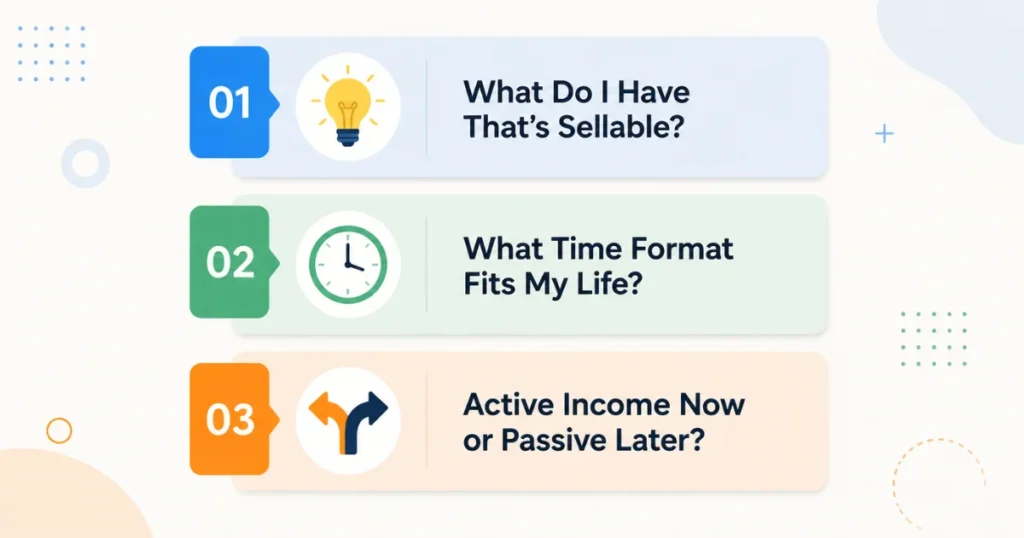
The question isn’t “what can I do to earn extra money?” It’s three more specific questions:
- What do I have that’s already sellable? Skills, knowledge, professional experience, creative ability — you almost certainly have something that someone else will pay for. Finding it is step one.
- What time format works for my actual life? Do you have evenings? Weekends? Scattered thirty-minute gaps? Different side hustles require different time formats. Matching the hustle to your reality is what determines whether it actually gets done.
- Do I want something that pays me now, or something that pays me later? Active income (trading time for money) generates cash quickly. Passive income (building something that earns over time) requires front-loaded effort and patience. Most people need some of both.
Answer those three questions before picking a side hustle and your chances of actually sticking with it go up dramatically.
READ MORE: How to Start a Blog and Make Money From It
Smart Category 1: Monetizing What You Already Know
The fastest path to extra income almost always runs through skills you already have — not skills you’re planning to learn.
This sounds obvious. But an extraordinary number of people I’ve talked to are sitting on genuinely marketable skills they give away for free or don’t think of as sellable. The colleague who everyone asks to fix their spreadsheets. The person whose work emails are always better than everyone else’s. The friend who explains complex things clearly in meetings and could do the same for clients.
How to identify your sellable skill:
Ask yourself what you’ve been paid to do, or what people ask for your help with even without being paid. Both are signals.
Then ask: is there a version of this that someone would pay me for directly?
If you’ve built complex Excel models at work, small businesses would pay you to build theirs. If you’re a native English speaker and your company has hired you partly because of your writing ability, non-native business owners would pay for your editing. If you manage social media as part of your job, local businesses need exactly that expertise.
The professional services freelancing path:
This is the most straightforward. Take your professional skills to a freelancing platform and offer them as a service.
- Upwork for most professional services (writing, design, development, marketing, finance, legal, HR)
- Fiverr for creative and digital services with clear deliverables
- LinkedIn for consulting and B2B professional work
Rates to expect: Depending on the skill and niche, beginners with professional experience can realistically charge $25–$75/hour from the start. This isn’t speculative — it’s what professional services freelancers with relevant backgrounds actually charge when they position themselves correctly.
The positioning move that changes everything: Instead of “I offer writing services,” say “I write email sequences and product copy for e-commerce brands in the wellness space.” Narrower is stronger. Specific clients know immediately whether you’re right for them, and specific positioning commands higher rates than generic.
READ MORE: Best Blogging Platforms That Actually Work
Smart Category 2: Building Passive Income Streams
Active freelancing gets you paid quickly. But it has a natural ceiling — the hours you can work. Passive income has a different ceiling: the size of the audience or market you can reach.
In 2026, the tools for building passive income are more accessible than they’ve ever been.
Digital products: Create once, sell repeatedly, platform handles fulfillment.
The template: identify a specific problem a specific person has. Create a resource that solves it — a PDF guide, spreadsheet template, Canva design pack, prompt library, checklist series, or mini course. List it on Gumroad, Etsy, or Payhip. Drive traffic through Pinterest, LinkedIn, or a simple blog.
A $15 product sold to twenty people per month is $300/month from something you built once. Ten products across multiple niches changes that math significantly.
What makes a digital product actually sell:
Not how polished it looks. Not how long it is. Whether it solves a real, specific problem for a real, specific person.
“Productivity planner” competes with thousands of identical listings. “Content batching planner for freelance social media managers” competes with almost nobody and speaks directly to exactly the right buyer.
Affiliate marketing through content: You create content (blog posts, YouTube videos, newsletters) that recommends products and earns commissions when readers buy through your links.
The smart version of this in 2026 involves evergreen content — posts and videos that answer questions people will be searching for years from now, not content tied to trending topics that fade in weeks.
A well-written blog post targeting the right keyword can drive organic traffic for years. Each visit is a potential commission. The work done once keeps earning.
The honest timeline: This takes longer than most people want. Most blogs and YouTube channels don’t generate meaningful passive income until month six to twelve. But the income that builds after that point doesn’t require proportionally more work.
Smart Category 3: AI-Augmented Services
This is the category that’s created genuinely new opportunities in the last two years — and most of the “side hustle” conversation hasn’t caught up to it yet.
There are two angles here.
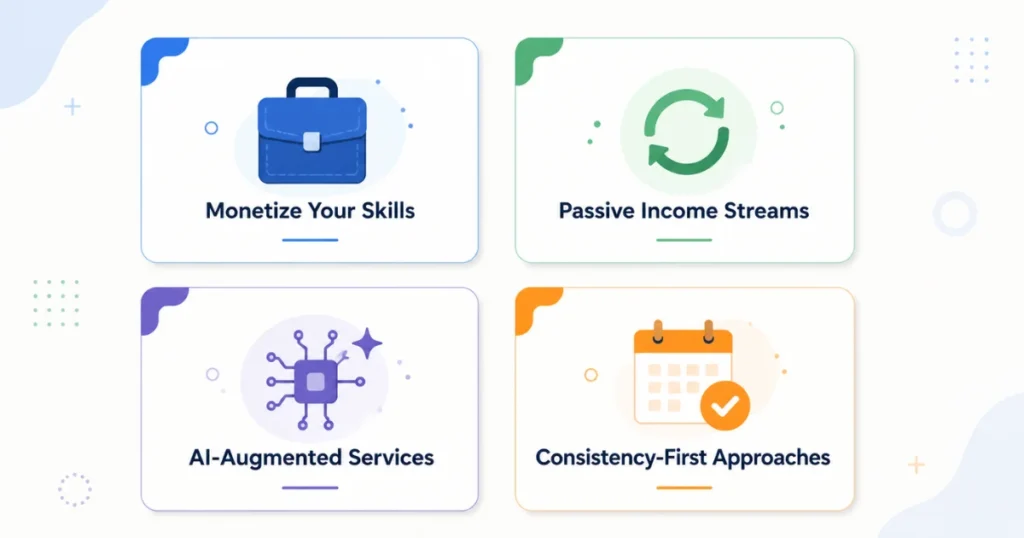
Using AI to do your existing work faster and better. This isn’t a new income stream on its own — it’s how you make your current side hustle more profitable. Writers using AI tools produce more in less time. Designers using AI image generation tools expand what they can offer. Virtual assistants using automation tools handle more clients. The tool enhances the skill; the skill earns the money.
Offering AI implementation as a service. This is the new, high-demand category. Businesses know AI tools exist. Most of them have no idea how to use them effectively in their operations.
Freelancers who can audit a small business’s repetitive tasks and set up AI workflows — using Make or Zapier to automate processes, building GPT-based tools for internal use, implementing AI writing tools into content workflows — are finding clients who’ll pay $500–$2,000 for a single implementation project and $300–$800/month for ongoing support.
The barrier is lower than it sounds. You don’t need to be a developer. You need to understand business workflows, know how to use no-code tools like Make, Zapier, and Notion, and be able to explain what you’ve built to a non-technical client.
If you’re already reasonably tech-comfortable and interested in this space, twenty to thirty hours of learning on YouTube and in Make’s documentation is enough to take on first clients.
Smart Category 4: The Consistency-First Approaches
Some side hustles don’t require rare skills or technical tools — they require showing up consistently. These are less likely to make you rich quickly, but they’re real, accessible income that compounds with time.
Building a niche audience: A newsletter, blog, or YouTube channel in a focused niche earns through ads, sponsorships, and affiliate income once it has an engaged audience. The income sounds small early — $50/month at three hundred subscribers isn’t impressive. But a newsletter at two thousand engaged subscribers in a monetizable niche earns $500–$1,500/month and keeps growing without a proportional increase in workload.
Tutoring: If you’re strong in any subject, skill, or language, tutoring provides consistent, predictable income at genuine hourly rates. Four regular weekly students is around $600–$800/month for eight to ten hours of work. The work is real and requires real effort, but the income-to-hours ratio is among the best available for knowledge-based side work.
Reselling: Buying undervalued items and reselling them online is one of the oldest side hustles and still works for people with good eyes for value and a willingness to learn one specific category. Vintage clothing, specific electronics, branded items, Lego, vinyl — people who develop real expertise in one category build reliable monthly income from it.
What’s Actually Different About Side Hustles in 2026
I mentioned earlier that something has genuinely shifted. Let me be specific about what.
The tools cost much less. Running a proper freelancing business, digital product shop, or content operation used to require significant software investment. Free or very cheap tiers of professional tools — Canva, Gumroad, ConvertKit, Buffer, CapCut, Claude, ChatGPT, Notion, Airtable — mean the barrier to serious side income is genuinely lower than it’s ever been.
Global reach is standard. A freelancer in 2016 was mostly competing in their local market. A freelancer in 2026 is working with clients on three continents without that being remarkable. This expands the potential client pool enormously, especially for digital services.
Niche audiences are profitable at smaller sizes. The creator economy has matured. A newsletter with 1,500 engaged subscribers in a specific professional niche can attract paid sponsorships. A YouTube channel with 8,000 subscribers who are all small business owners attracts B2B sponsors who pay well per placement. You don’t need mass audiences — you need the right audiences.
AI changes the effort curve. The time required to produce certain types of work has genuinely dropped for skilled practitioners who use AI tools well. This means either more projects per hour, higher quality output in the same time, or the same quality in less time. All three increase the effective hourly rate of knowledge work.
READ MORE: Best Skills to Learn for Blogging & Online Income
Mistakes That Keep Smart People From Building Extra Income
Over-planning, under-starting. The amount of time spent researching side hustle options, reading reviews of platforms, watching YouTube videos about what to do, and building elaborate plans — without ever actually starting — is enormous. Most platforms reward action over perfection. Start before you’re ready.
Switching too often. A side hustle that’s “not working” after three weeks usually hasn’t been tried long enough to know. Six to eight weeks of consistent, focused effort is the minimum before drawing conclusions. The people who build something real are almost always the ones who stayed with something through the slow early phase.
Choosing income first, sustainability second. Some side hustles with high theoretical income don’t fit your actual energy level, schedule, or interests. A highly paid side hustle you dread doing and gradually abandon is worth less than a moderately paid one you maintain consistently for two years. Fit matters.
Ignoring the compound effects of small starts. A $200 month feels trivial. But the skills, client relationships, reviews, and infrastructure built during that first $200 month are what enable a $600 second month and a $1,000 third month. The early money is rarely the point — the early building is.
Trying to skip the trust-building phase. On every platform and in every market, income follows trust. Trust is built through samples, reviews, testimonials, consistent content, and time. There’s no shortcut that genuinely works — but there are faster paths. Building specific samples, reaching out directly to relevant potential clients, and asking satisfied clients for referrals all accelerate trust-building without skipping it.
A Practical Starting Framework
For anyone who wants to go from reading this to actually doing something:
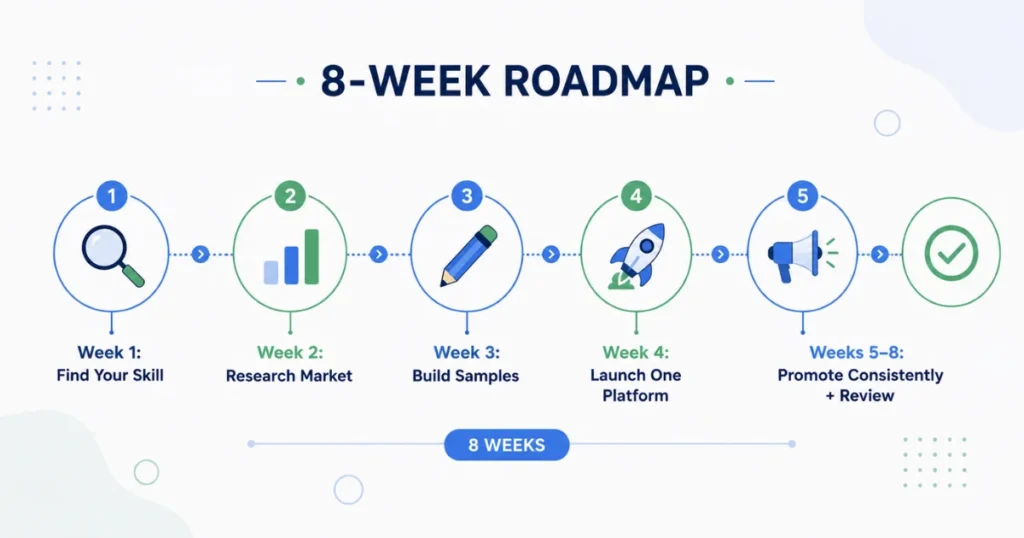
Week 1: Identify your sellable skill. What do people ask you for help with? What have you been paid to do? What comes easily to you that’s difficult for others?
Week 2: Research the market. Look at what similar services charge on Upwork and Fiverr. Search for related digital products on Gumroad and Etsy. Understand what people are paying and what’s already out there.
Week 3: Create your proof of skill. Two or three samples that represent the work you’ll do for clients. These don’t have to come from real clients — made-up examples are fine.
Week 4: Choose one platform and launch. One profile, one gig, or one product listing. Not three platforms simultaneously. One, done well.
Weeks 5–8: Apply or promote consistently. Send proposals. Post about your product. Share your work. The rule of thumb: whatever feels like enough activity, do slightly more.
Week 8 review: What happened? What worked? What needs adjustment? Build the second month based on actual data, not assumptions.
What Consistent Effort Builds
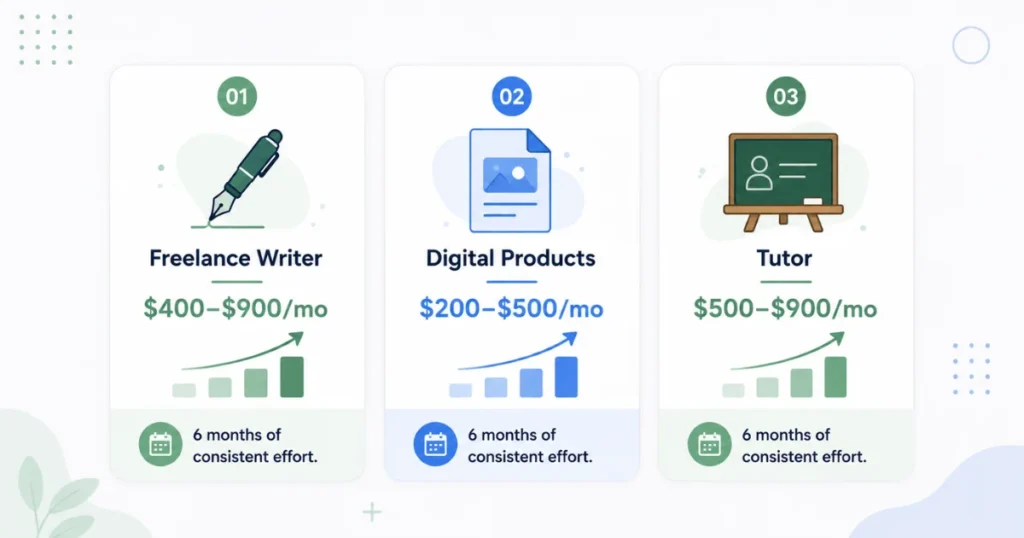
I want to give an honest picture of what six months of real, consistent side hustle work looks like — not the highlight reel, but the normal version:
A writer who commits to Upwork for six months, writes consistently, and delivers quality work: $400–$900/month, two to three regular clients, starting to get inbound inquiries.
Someone who builds digital products consistently and promotes them on Pinterest: three to five products live, $200–$500/month in mostly passive income.
A tutor who fills a weekly schedule and gets referrals from happy students: $500–$900/month working eight to ten hours per week.
None of these are extraordinary. All of them are achievable. And all of them compound — the income, the skills, the client relationships, and the systems all get stronger over time.
The tools are better than they’ve ever been. The opportunities are real. What they require — and what they’ve always required — is the decision to start and the consistency to keep going past the point where it’s still uncertain.
FAQs
How much time does it actually take to build a side income?
For active income (freelancing, tutoring): two to four weeks to land a first client with consistent effort. For passive income (digital products, content): two to four months before meaningful recurring income. Plan for the longer timeline; anything faster is a bonus.
Do I need to invest money to start earning extra income?
For most digital side hustles, no meaningful upfront investment is required. A domain ($10–$15/year) and basic hosting ($3–$5/month) are the only real costs for a blog. Platforms like Fiverr, Upwork, Gumroad, and Etsy are free to join.
What’s the most sustainable side hustle for someone who already feels stretched?
The one that fits your existing life most naturally. If you’re exhausted, tutoring two hours on Saturday mornings is more sustainable than a daily content creation schedule. Fit beats theoretically higher income every time.
Is passive income actually passive?
Not at the start. Building passive income (digital products, content, affiliate marketing) requires concentrated upfront effort. Once it’s built and generating, the maintenance is genuinely minimal — but that point takes months to reach. “Passive eventually” is more accurate than “passive now.”
How do I stay motivated when growth is slow early on?
Track effort, not income. In the first six to eight weeks, you can’t fully control whether clients say yes or whether products sell. You can control how many proposals you send, how many products you create, how consistently you show up. Focus the measurement on the inputs until the outputs catch up.