
I have a spreadsheet I check maybe once a month now. It tracks income from eleven digital products I’ve built over the past two years.

Most months, that spreadsheet shows somewhere between $900 and $1,600 — money that arrives without me actively working for it that day, that week, sometimes that month. I didn’t build all eleven products at once. I didn’t have a master plan from day one. I built one, learned from it, built another, got slightly better, and kept going.
I want to be upfront about something before this turns into another “passive income” article that oversells the dream: this took real, sustained effort to build, and it’s still not fully hands-off. I update product descriptions occasionally. I respond to customer questions. I create new pins for Pinterest every few weeks. It’s passive in the sense that I’m not trading hours for dollars anymore — but it’s not passive in the sense of zero ongoing involvement.
What I’m sharing here is the actual strategy that worked — not a theoretical framework, but the specific approach, mistakes, and decisions that got me from zero digital products to a genuinely working income stream.
What “Passive Income From Digital Products” Actually Means
Let’s get precise about the model, because vague understanding leads to frustrated expectations.
A digital product is something you create once — a guide, template, planner, prompt pack, spreadsheet, course, or similar downloadable resource — and sell repeatedly without recreating it for each sale. The platform you sell through (Gumroad, Etsy, Payhip) handles payment processing and delivery automatically.
The “passive” part refers to the fact that selling the hundredth copy requires the same effort as selling the first — none. You did the work once. The income compounds because the same asset keeps generating revenue.
What’s NOT passive: building the product, writing the listing, creating marketing materials, driving traffic, responding to customer service, and periodically refreshing or improving the product based on what’s working.
The realistic mental model: front-loaded effort, ongoing light maintenance, compounding returns.
Related: How to Create and Sell Digital Products
The Strategy: Building a Portfolio, Not a Single Product
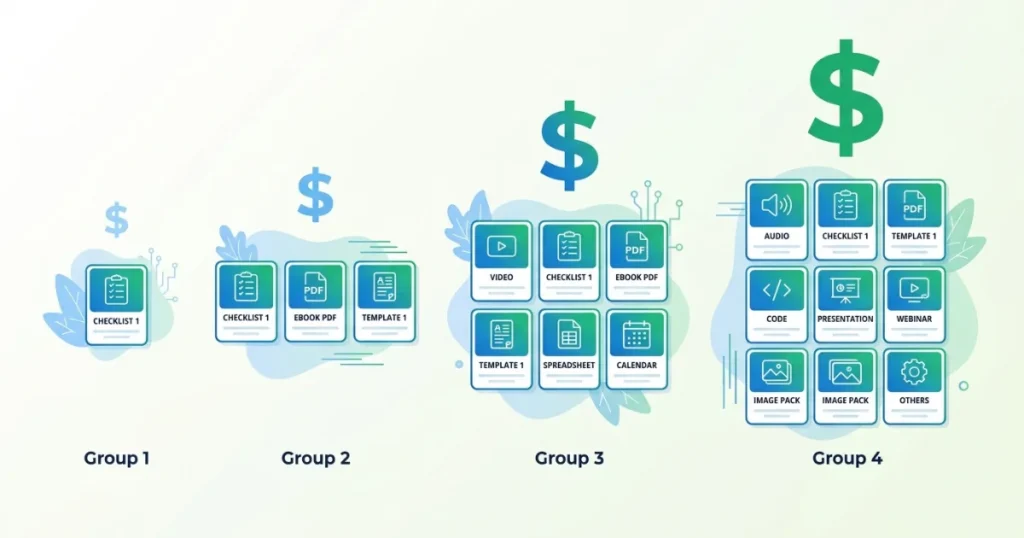
Here’s the single biggest insight from two years of doing this: one digital product rarely becomes a meaningful income stream on its own. A portfolio of related products does.
My first product made about $40 in its first month. Disappointing on its own. But it taught me what worked — what title language drove clicks, what price point converted, what platform performed better for my niche. Product two, built with those lessons, made $180 in its first month. Product three made $310.
Each product also cross-promotes the others. Someone who buys a budgeting template might also want the linked debt payoff tracker. Someone who buys a social media caption pack for fitness coaches might want the matching content calendar template.
The compounding effect of a portfolio:
One product earning $150/month is a nice side project. Ten related products, each earning $100–$300/month, is $1,000–$3,000/month — and that’s a genuinely different category of outcome from a single hit product.
This reframes the whole strategy. You’re not trying to create one perfect, comprehensive product. You’re trying to build a connected catalog over time, with each addition compounding the value of what came before.
Step 1: Choose a Niche With Real Buying Behavior
This is where most people — myself included, the first time — get it wrong.
I initially built a product around a topic I found personally interesting (productivity systems for creative writers) without checking whether that audience actually buys digital products regularly. They engage with content, sure. But the buying behavior wasn’t strong in that specific niche.
What makes a niche good for digital products:
The audience has demonstrated willingness to pay for solutions — check Etsy and Gumroad for existing successful products in the space. If there are several established sellers with hundreds of reviews, that’s not a red flag — it’s confirmation that buyers exist and spend money there.
The audience has specific, recurring problems that a template, guide, or system can solve. “People who want to feel more organized” is vague. “Wedding planners managing multiple client timelines” is specific and has a recurring, definable problem.
The niche allows for a product family, not just one item. Can you imagine five, ten, fifteen different products serving this same audience? If the niche only supports one obvious product, the portfolio strategy doesn’t work as well.
Niches that have consistently strong digital product buying behavior: wedding planning, small business owners (especially solopreneurs), teachers and homeschool parents, freelancers and content creators, fitness and wellness coaches, real estate agents, Etsy sellers themselves, personal finance and budgeting, event planning, and parents of young children.
Step 2: Build Your First Product as a Learning Exercise, Not a Masterpiece

The instinct when starting is to make the first product perfect — comprehensive, beautifully designed, exhaustively thorough. Resist this.
Your first product should be good enough to sell, fast enough to actually finish, and specific enough that you’ll learn real lessons from real buyer behavior.
My actual first product: A twelve-page budgeting template pack built in Canva over a weekend. Not exhaustive. Not revolutionary. Solved one specific problem (tracking irregular freelance income against fixed monthly expenses) for one specific audience (freelancers with variable income).
Why starting smaller works better than starting big:
You learn faster. A small product gets built and listed in days, not months — meaning you get real market feedback (or lack of it) quickly, rather than spending months building something based on assumptions.
You reduce sunk cost anxiety. If a small product doesn’t sell well, pivoting or trying a different angle costs little. If you’ve spent three months on a comprehensive course that doesn’t sell, the emotional and time cost of pivoting is much higher.
You build momentum. Finishing and launching something — even something modest — creates the habit and confidence needed to build the next one, and the next.
Related: Best Digital Products to Sell Online
Step 3: Validate Before You Build (The Step I Skipped Early On)
I built my second product — a social media content calendar — without checking whether anyone wanted it first. It sat at low sales for two months before I figured out the audience I’d targeted wasn’t quite right.
The validation step that actually works:
Before building, post in a relevant Facebook Group, subreddit, or online community where your target audience hangs out. Describe the product concept simply: “Would something like [specific description] be useful to you? Would you pay around $[X] for it?”
You’re not asking for a comprehensive market research report. You’re looking for a quick directional signal — enthusiastic responses, lukewarm silence, or active pushback all tell you something before you’ve invested real time.
Alternative validation: check existing demand. Search Etsy and Gumroad for similar products. Are there established sellers with strong review counts? That’s market validation — proof people buy this type of thing. If you find zero existing products of this type anywhere, that’s either an untapped opportunity or, more often, a sign there’s no real demand.
Step 4: Create the Product Efficiently Using the Right Tools
For PDF guides and ebooks: Canva (free tier is genuinely sufficient) for layout and design. Google Docs for drafting the actual content before formatting.
For templates (social media, planners, trackers): Canva for visual templates. Google Sheets or Excel for functional spreadsheets and trackers.
For Notion-based products: Notion itself, using their template-sharing and duplication features to deliver the product.
For prompt packs: Test every prompt in ChatGPT or Claude before including it. A prompt pack with untested, mediocre prompts generates poor reviews and refund requests.
Using AI to speed up creation: Claude or ChatGPT can help draft content, outline structure, and generate ideas for product variations significantly faster than starting from a blank page. I use this for the planning and drafting phase — the actual design, judgment about what’s genuinely useful, and final polish stay mine.
Realistic creation time for a focused product: One to two weekends for most template packs or short guides. Longer for comprehensive courses or extensive template libraries — but remember, starting smaller is the better strategy for your first few products.
Step 5: Write a Listing That Actually Converts
The product matters, but the listing is what gets someone to click “buy.”
What works for digital product listings:
A clear, specific title that states exactly what the product is and who it’s for — not vague or “creative” language. “Wedding Day Timeline Template for Planners | Editable Canva Client Schedule” beats “Beautiful Wedding Planning Tool.”
A description that opens with the specific problem solved, lists exactly what’s included (number of pages/templates, format, editable software needed), and addresses the most likely hesitation a buyer might have (Can I edit this? Do I need special software? Is this beginner-friendly?).
Clean, professional preview images that show the actual product, not abstract decoration. Buyers want to see what they’re getting.
Where to sell: Gumroad (simplest setup, free start, ~10% fee, good for direct promotion and email list sales) and Etsy (built-in search traffic, especially strong for templates and printables, small listing fee plus transaction fees) are the two I use most. Listing on both, where the product fits Etsy’s marketplace, doubles your discovery channels for minimal extra effort.
Step 6: Build Traffic Systems That Run Without You
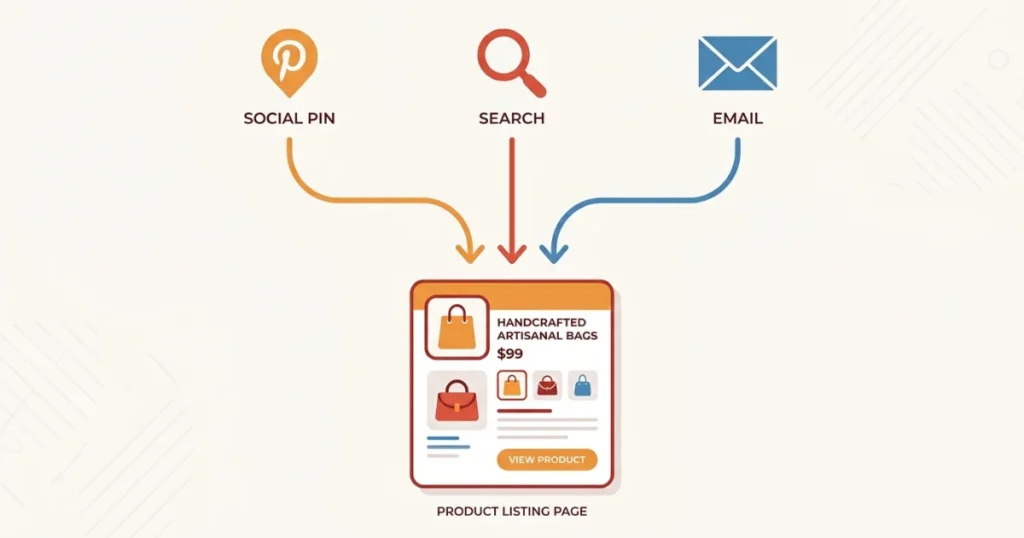
This is the part that actually makes the income passive over time — because creating great products that nobody finds generates zero income.
Pinterest is the single most effective free traffic source I’ve used for digital products. Unlike Instagram or TikTok, Pinterest functions as a visual search engine. A well-made pin with a keyword-rich description can drive traffic for months or years after you create it.
My actual Pinterest workflow: Create three to five pins per product in Canva (different angles, different headline approaches), write keyword-rich descriptions matching what my target buyer would search, and schedule them using Tailwind’s free trial or Pinterest’s native scheduler. I spend about an hour every two weeks on this — a small recurring time investment that drives a meaningful portion of my ongoing traffic.
Etsy’s internal search traffic compounds on its own once a listing has solid SEO (specific titles, all thirteen tags used, accurate categories) and a few reviews. This requires almost no ongoing effort once set up correctly — Etsy’s algorithm does the discovery work.
Email list: Every product launch goes to my email list (built using ConvertKit’s free tier) first. This warm audience converts at a much higher rate than cold traffic and gives every new product an initial sales boost that also improves its organic ranking on whichever platform it’s listed.
SEO blog content (if you have a blog) pointing to your products is a slower but durable traffic source. A blog post answering a question your target buyer searches for, with a natural link to your relevant product, can drive sales for years.
Step 7: Expand the Portfolio Strategically
Once your first product is live and you’ve learned what works, the path forward is building related products that serve the same or adjacent audience.
How I decide what to build next: I look at what’s selling well and ask what naturally complements it. The budgeting template led to a debt payoff tracker, which led to a savings goal planner, which led to a “financial reset” bundle combining all three at a discount.
The bundle strategy: Once you have three or more related products, bundling them together at a slight discount (e.g., three products individually priced at $12 each, bundled at $28) increases average order value and gives buyers a reason to get everything at once rather than just the one they found first.
Expanding into adjacent niches: Once one niche portfolio is established and generating consistent income, the lessons learned (what platforms work, what pricing works, what marketing channels convert) transfer to building a second niche portfolio — diversifying your income across multiple audiences.
Related: Selling Digital Products Online: Step-by-Step Guide
Mistakes That Slowed Me Down
Building before validating. Cost me roughly six weeks of work on a product that needed significant rework after I finally checked whether the audience actually wanted what I’d built.
Pricing based on insecurity rather than value. My early products were priced too low because I doubted whether anyone would pay more. Once I started pricing based on the actual value delivered (time saved, problem solved) rather than my own anxiety, both conversion rates and overall revenue improved — counterintuitively, slightly higher prices sometimes converted better because they signaled quality.
Neglecting the email list for too long. I didn’t start building one until product number four. Every sale before that was a missed opportunity to build a direct audience for future launches.
Spreading across too many niches too early. I tried to build products for three different audiences simultaneously in my first few months. None of the three got enough attention to develop real momentum. Focusing on one niche until it has five or six solid products before branching out would have been faster.
Not tracking what actually drove sales. For the first several months, I didn’t track which traffic source (Pinterest, Etsy search, email) drove which sales. Once I started tracking this in a simple spreadsheet, I could see clearly that Pinterest was outperforming my other efforts for certain product types — information that let me focus my limited time more effectively.
A Realistic Income Timeline
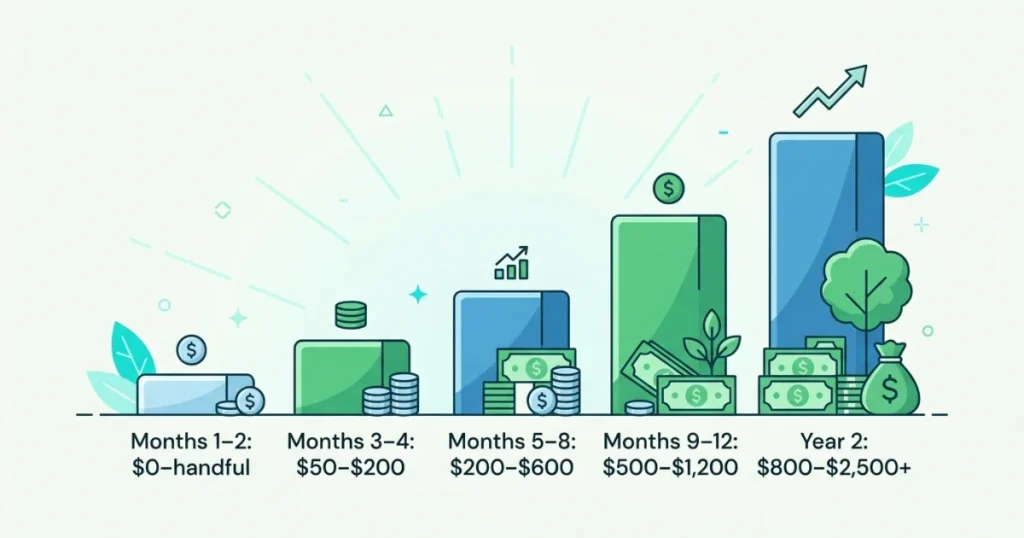
Months 1–2: First product built and listed. Sales: minimal, possibly zero to a handful. This is normal — you’re gathering initial reviews and feedback, and your listing’s SEO is still unproven.
Months 3–4: With Pinterest traffic building and Etsy SEO starting to take effect (if applicable), first consistent sales pattern emerges. Income: $50–$200/month from one or two products.
Months 5–8: Second and third products launched, building on lessons from the first. Cross-promotion between products begins working. Income: $200–$600/month across the small portfolio.
Months 9–12: Five to eight products live, Pinterest and Etsy traffic compounding, email list providing launch boosts for new products. Income: $500–$1,200/month.
Year 2: With ten or more products, multiple traffic sources working simultaneously, and possibly a second niche portfolio started — income in the $800–$2,500+/month range becomes realistic for someone who’s stayed consistent.
These ranges reflect genuine, achievable outcomes for consistent effort — not exceptional outlier results, and not overnight success stories.
What This Actually Requires (Honest Time Commitment)
In the building phase (first three to four products): four to eight hours per week, mostly on weekends or evenings, split between product creation and traffic-building activities.
Once the portfolio reaches eight to ten products: two to four hours per week of maintenance — creating new pins, responding to customer questions, occasionally refreshing underperforming listings, and adding a new product every month or two.
This is genuinely less time than the income suggests, which is the entire point of the model. But it required those first several months of more concentrated effort to reach that point.
Closing Thoughts
That spreadsheet I check once a month didn’t happen by accident, and it didn’t happen quickly. It happened because I built one thing, learned from it honestly, built a slightly better second thing, and kept that pattern going for two years without expecting any single product to be the answer.
The “passive income from digital products” framing that gets sold online skips the building phase entirely and jumps straight to the spreadsheet number. That’s misleading. The spreadsheet number is real, but it’s the result of a process — not a shortcut around one.
If you’re starting this, expect the first few months to feel like real work for modest returns. Expect the returns to compound if you stay consistent and build a connected portfolio rather than chasing one perfect product.
That’s the actual strategy. Not a hack. A process that works if you give it the time it requires.
FAQs
How many digital products do I need before I see real passive income?
Most people see meaningful, noticeable income once they have five to eight related products live, generally around months six to nine of consistent effort. A single product rarely generates significant passive income on its own.
What’s the best platform to sell digital products for passive income?
Gumroad for simplicity and direct promotion, Etsy for built-in organic search traffic (especially for templates and printables). Many successful sellers use both simultaneously for maximum discovery.
How much time does it take to maintain a digital product portfolio once it’s built?
Once established (eight or more products), two to four hours per week is typical for maintenance, new pin creation, and occasional new product additions. The early building phase requires significantly more time.
Do I need an audience or following to sell digital products?
Not at the start. Etsy’s built-in search traffic and Pinterest’s organic discovery can drive your first sales without an existing following. An audience (email list, social following) accelerates growth significantly but isn’t a prerequisite to begin.
What’s the biggest factor in whether a digital product portfolio succeeds?
Consistency over time, combined with genuine validation before building. The people who succeed build steadily over months, check whether their audience actually wants what they’re making, and treat early products as learning opportunities rather than expecting instant success from the first attempt.