I Created a Digital download — And It Made More Money Than My First Freelance Job! — Here’s How.
A few months ago, I woke up at 2 AM. When I checked my Gumroad account I saw a little notification stating “You just made a sale”

Interestingly, it was for a 12-page PDF document that I had created earlier that same evening in Notion. It took me roughly 2 – 3 hours to build this document containing basic guidelines for creating a content calendar for small businesses.
I had priced my document at $7. But when I made the sale I was in bed asleep, the sale was made by someone who lived half way around the world in Germany and who found me via Pinterest. I had almost forgotten that I even had a pin on Pinterest.
That was when I really experienced what it meant to have created a digital product. It was not an academic concept from reading about it in school, it was a real live experience of earning money.
What are Digital Products
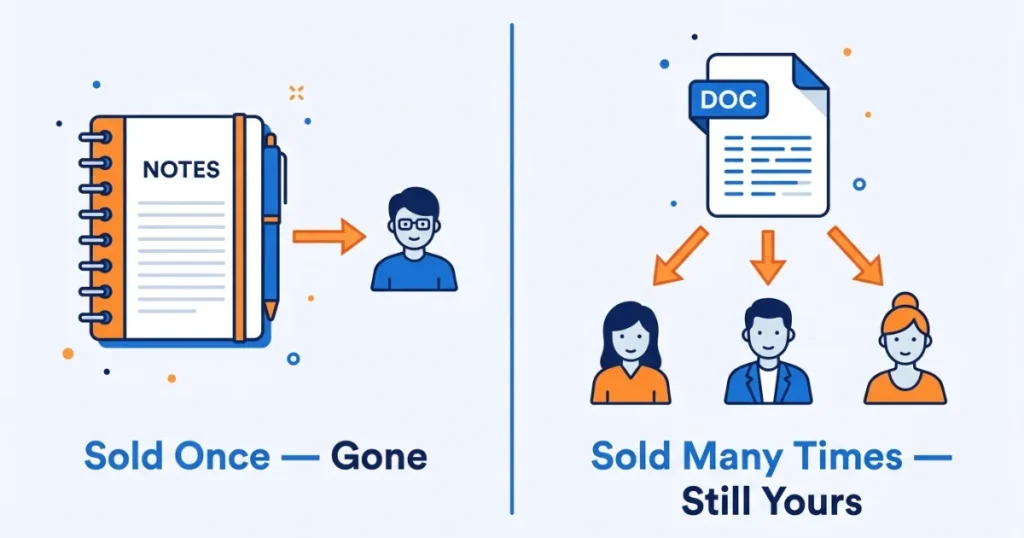
In simple terms, a digital product is anything that you create once, and can be sold (or given away) many times without running out of stock. You don’t need to have a warehouse to store your product. You don’t need to prepare the product for shipping or putting it into packaging again and again. You create it, someone pays for it, they download it (or otherwise gain access to it), and you still have a copy of that product.
What I find particularly amazing is that our example of a digital product is similar to our example of a traditional product. If you sell me a physical notebook then that means you have one less notebook. If you sell me a Notion template or a Lightroom preset pack, though, you have not lost a notebook because you still maintain your digital file of that product. At the same time, I now have my own copy of that same file and so does the next person who buys one from you. And so on…
Some Examples of Digital Products
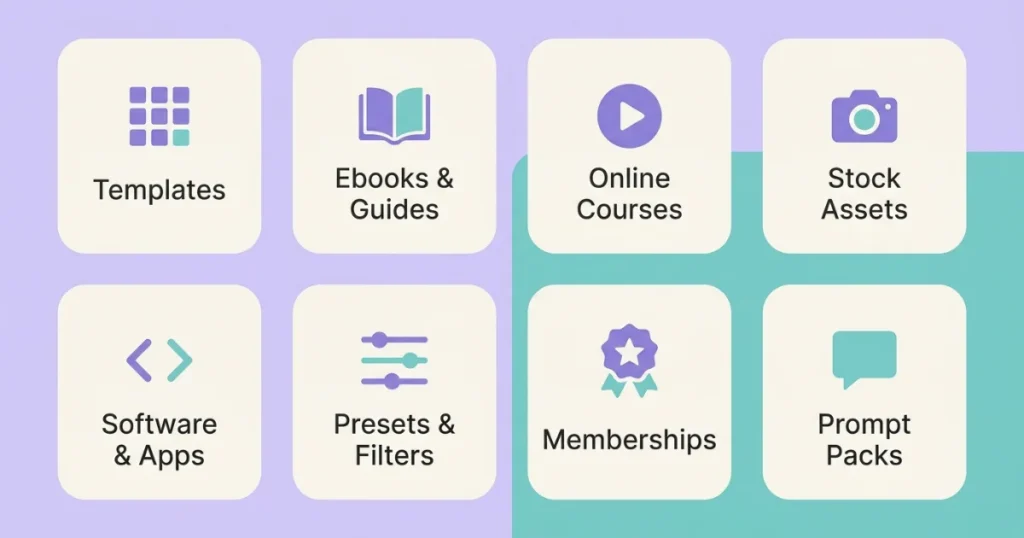
I have a lot of templates that I use, like the ones from Notion and Canva and Excel. Also email sequences.
I also have e-books and guides that’re in PDF form and these are like long pieces of written content.
Sometimes I take online courses that have video lessons and these are usually hosted on platforms like Teachable or Kajabi or Podia.
I like to use stock assets like photos and fonts and icons and music and video clips.
There are also software and apps that I use, such as software as a service and browser extensions and mobile apps.
I have presets and filters like the ones for Lightroom and Photoshop actions and also video LUTs.
I am part of memberships and communities, like paid newsletters and Discord servers and Patreon tiers.
Read More: Best Digital Products to Sell Online (2026 Guide)
Mistakes that shaped My Journey
When folks were discussing “digital product sales,” I thought it meant having something more technical. Like developing a mobile app, or an extensive quantity of video content for a course. That’s when I sat on the sidelines for nearly a year.
After that, one day I saw a person on Twitter talking about how they made $3,000 by selling a Notion dashboard (that they created for their own purposes) as a product. They did not need a website – they simply provided a Gumroad link in their Twitter bio.
Now that was the slap I needed!
The mistake I made was that I thought “product” meant developing a more complex type of product, when it simply means creating or producing a digital product that will help solve a specific problem for a specific type of “customer”. That is it.
For example, I created a PDF calendar because it would help meet the need for “I do not know what to post on social media next week.” Admittedly, that is not a life-changing product, however, there were enough small businesses in Germany (like me) trying to figure out what content to post so I received $7 of business in three minutes when I launched my digital product at midnight!
Understanding How Digital Products Work (The Process)
Let’s take time to explain how digital products operate behind the scenes since it is easier than most people think:
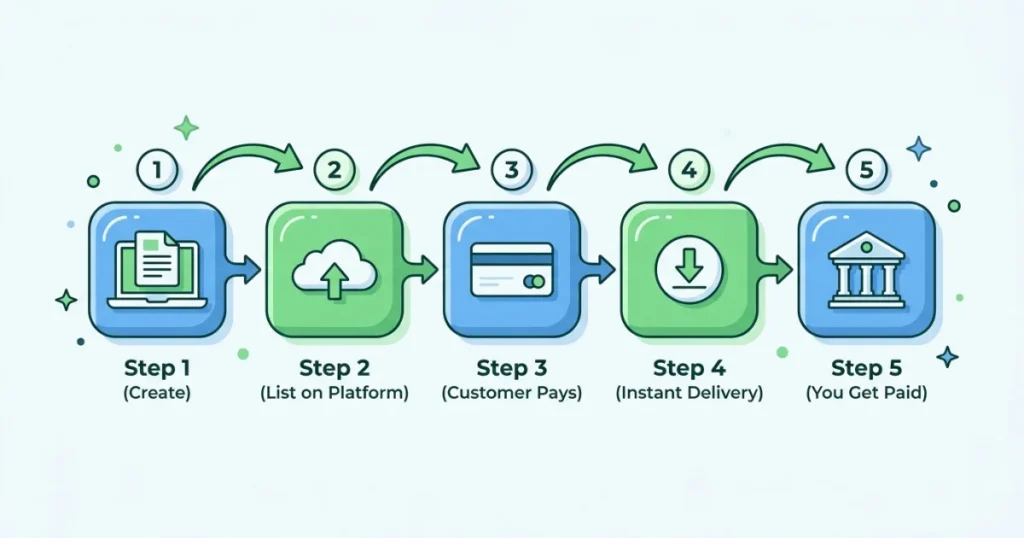
The process of creating a Successful digital product
Step 1: Creating a digital product often includes recording a video using Loom, creating a pdf in Canva, using Notion or Airtable to design templates, or teaching an online course through Teachable. The way you use these tools will depend on what type of digital products you are making.
Step 2: You need to find a website where you can sell your product and allow your customers to download what they purchased. If you plan to sell small files, I recommend using Gumroad or Payhip. All you need to do to set up an account is sign up, upload your digital file, create a price for your product, and create a unique link to sell your digital products. When you are selling online courses, you would typically use Teachable or Thinkific. These provide you with a function for hosting videos, organizing your lessons, accepting payment for your course, etc. When you are selling software, this can get a little bit more tricky; however, if you use a tool like Stripe to process your billing, and your software is stored on your own server, you will be set up for success!
Step 3: Your customer can pay for a digital product through credit card, Paypal or other methods you have offered. The website where your product has been listed will handle processing the transaction and collecting the fees from the sale and then sending you the remainder of the funds.
Step 4: As soon as your customer completes the transaction, your customer will be provided instant access to the product. If they purchased a digital product file, they will download their product, or they will log on to a website, so they can access your content; no waiting and no need for a tracking number.
Step 5: You will need to wait until the next billing cycle is complete to receive your money.
Read More: Create and Sell Digital Products (Complete Guide)
Reasons Why Many People and Companies Are So Excited About This Right Now
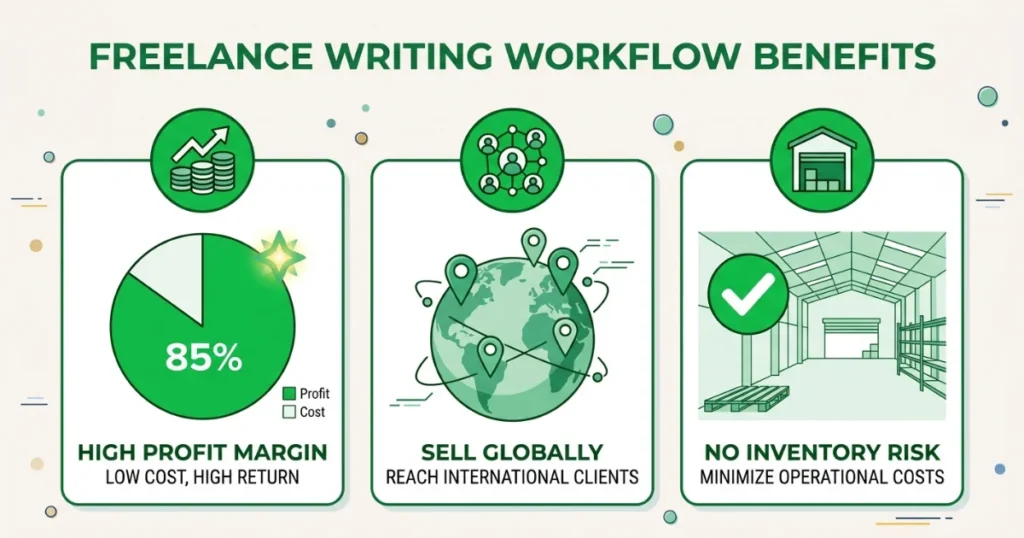
Numerous people get excited about passive income from digital products generated via the internet because it is possible. Passive income from digital products can be generated through individual transactions, creating a great return on investment. The primary reason for the continued growth of this segment of the e-commerce market is related to the incredible profit margin generated with digital products.
Profit Margins: For example, if I sell a $30 physical product and my cost to acquire, create, package, and ship that product is $15, I keep $15. If I sell a digital product for $30, the only costs associated with selling that digital product are the initial creation and design expenses. Even when factoring in platform transaction fees, my profit margin remains on average 80-90% or more.
Global Business at No Additional Work: If you read my previous post about my German customer, I did nothing different to reach that customer than I do to reach any of my American customers. My German customer simply found my product via the Internet. I can sell to someone on the other side of the world (Tokyo, Japan) at the same cost as I can sell to someone down the street.
No Inventory Risk: Many traditional product-based businesses face the risk of being left with a lot of unsold inventory. This inventory usually generates a significant expense for product-based businesses to stock or purchase these products. When businesses sell digital products, they don’t face the risk of holding unsold inventory.
Ability to Update Without the Need for Reprinting: If I happen to notice a typographical error in one of my digital PDF products, I can edit the file, save it as the updated or fixed version, and to the date of download, anyone who downloads my PDF after the fix will download the corrected PDF. There is no need to print or redistribute any of these previously printed or distributed copies.
Common Mistakes to Slow Down
Making it too general. “A productivity guide” is not entirely precise. “A productivity guide for ADHD freelancers working from home” is precise. The narrower your target audience, the easier it is for others to discover you, as well as for you to discover the right buyer.
Overcomplicating the first version. Version 1 does not need to be flawless. Some people I know spent 6 months “perfecting” their course before releasing it and received no sales at launch. On the other hand, others released an unpolished 20-page PDF that resulted in a total of 200 units sold by way of early launch and then modifying based on feedback.
Selecting the incorrect platform for your current stage. Gumroad works well for launching quickly, but, as your sales volumes and demands for customization grow and exceed limitations, you will need to migrate to another platform. Knowledge about when to migrate is obtained only through experience.
Neglecting distribution. Making a mistake with distribution is the thing that can happen when you are making a product. It is not that hard to make a product. The hard part is telling people about the product all the time. You have to do things like get your product to show up on search engines, send out newsletters, use media and pay for ads. If you do not tell people about your product it is basically a file sitting in a folder on your computer. Your product, the product you made will not do anything for you if you do not promote the product.
Tips for Getting Started – If You Are Curious
Instead of having to take on a large or complicated project, I recommend starting with small, manageable incremental tasks: Try tackling one known issue (not a vague problem), preferably as simply as possible (a template, checklist or brief instructional guide) and post it on Gumroad (the process takes only about 20 minutes to set up). Charge a low amount (between $5–14) — enough to be considered an actual sale but low enough not to deter people; then list/offer it to your immediate audience (don’t wait until you think it is ready).
The learnings from the first few sales (even the first few near sales) will contribute to your overall educational experience of learning how to create a digital product more than any other course would ever provide!
Is Creating a Digital Product Going to Work For Your Objective?
Here are some honest questions I would consider before you go all in:
- Is there something you’re really good at that people often ask you for help with?
- Can you turn that skill into something like a guide or a video that others can use on their own?
- Do people come to you for advice on a topic?
- Can you create something that shares your knowledge with others?
Maybe you have a talent or know a lot about something that people want to learn. Could you make a tutorial or a short course that teaches others about it? You might have expertise in something that others want to learn from you.Can you package it in a way that’s easy for them to understand and use? Are you open to putting in genuine effort on the distribution process (as opposed to just the creation of your item)? If the answer is yes to all of those, then you should definitely consider exploring creating a digital product.
If your hope is to upload something and sit back, waiting for money to come in without doing any work moving forward, you may see that occasionally happen, but it certainly is not any kind of strategy, it’s just pure luck. The ones I’ve seen have created a sustainable living off of digital products are treating it as a business, not a lottery ticket.
One More Thing
The seven-dollar PDF I referenced from the beginning has generated $800 to date (very passively) from an item that I created on just an ordinary Tuesday night.
The reason I am sharing these numbers with you is not to boast, but to provide an example as to how surprising my earnings as a result of selling this PDF were, when I looked at those numbers for the first time. I almost stopped myself from publishing my PDF, because I thought that it was too simple, and therefore it wouldn’t mean anything to anybody.
Most people’s first digital product is typically something they assume everybody has already seen or done, and that’s generally why they sell so well.
FAQs
How to start digital products?
Choose a problem you’re good at solving. Write down what you know in a file or template. You can sell this on Gumroad or Etsy. Do not charge much between $5 and $20 is fine. Then start telling people about it. That is all you need to do for now. You will learn everything as you do it.
Can you really make money selling products?
yes. But not the way most people expect. I’ll be straight with you, it’s not a vending machine where you upload a file and money appears. But it’s also not a scam. It’s closer to planting seeds. Some take weeks to grow, some take months, and some never do — but the ones that hit can keep producing without much extra work from you.
What digital products are in high demand in 2026?
AI prompt packs, Notion templates, micro-courses, niche planners, and Canva design kits People are buying lots of products in 2026. They like things like AI packs, Notion templates and micro-courses. They also buy niche planners and Canva design kits. These are all things that people’re willing to pay for.
What is an example of a digital product?
I think a simple example is a PDF. You might have downloaded a PDF before without thinking about it.Maybe you got a free meal plan from a food blogger or a resume template from Etsy or a budgeting spreadsheet that someone shared on Pinterest. This is what I mean by a product. A digital product is something, like a PDF.
What Are 5 Examples of Digital Products?
Five solid examples of digital products are Notion templates, Canva design packs, budgeting spreadsheets, PDF guides or ebooks, and Lightroom preset packs — things you create once, sell endlessly, and never have to restock or ship.
Where can I buy digital products?
You can buy things on websites like Etsy, Gumroad, Creative Market, Teachable and Amazon Kindle. It depends on what you want. Like templates, courses, ebooks or design stuff. Most of them let you download things away after you buy them. You do not have to wait or worry about shipping. The stuff goes straight to your device.
What can I sell to make money?
To be honest, digital products are selling fast right now. You can sell things like Canva templates. Notion dashboards. PDF guides are also popular. Some people buy niche spreadsheets. The good thing about products is that you make them once. Then they keep selling without you having to do any work. If digital products feel too new you can sell your skills. You can offer writing services. Graphic design is another option. Video editing is in demand too. Some people pay for media management. You can start with zero cost.
What is the easiest digital product to make?
To be honest a digital product like a Canva template is probably the digital product to make. You just pick a niche then you design an Instagram posts or a resume layout for that niche and then you export it and the digital product is done. A digital product like a PDF guide or checklist is a second to a Canva template. This is because if you already know something about a particular niche you are basically just writing down what is already in your head, about that niche.
What is the selling digital product?
The selling digital product is definitely templates. Templates are really popular because people want something they can use immediately. They do not want to spend time creating something from scratch. People are buying things like Canva social media kits and resume templates. They are also buying Notion dashboards. These things are selling a lot on platforms like Etsy. The selling digital product, templates are selling so well because people want something ready to use right now.