
I started my first blog in 2019 and made exactly zero dollars from it.
Not because blogging doesn’t work — but because I made every mistake a beginner can make. I picked a topic I thought sounded impressive rather than one I actually cared about. I wrote sporadically, with no strategy behind the topics I chose. I had no email list, no monetization plan, and no understanding of how SEO worked.
I published seventeen posts over six months, got confused when nothing happened, and quietly stopped.
Three years later, I started over — this time with a clearer head and a much better understanding of what actually matters. Within nine months of the second attempt, I was making consistent income from that blog. Not life-changing money at first, but real and growing.
The difference between those two experiences wasn’t talent or luck. It was knowing what to do from the start — and actually doing it in order.
This guide is what I wish I’d had before blog number one. It covers every step you need to go from idea to a real, working, monetized blog — without wasting months on things that don’t matter.
First, Let’s Kill the Biggest Myth About Blogging
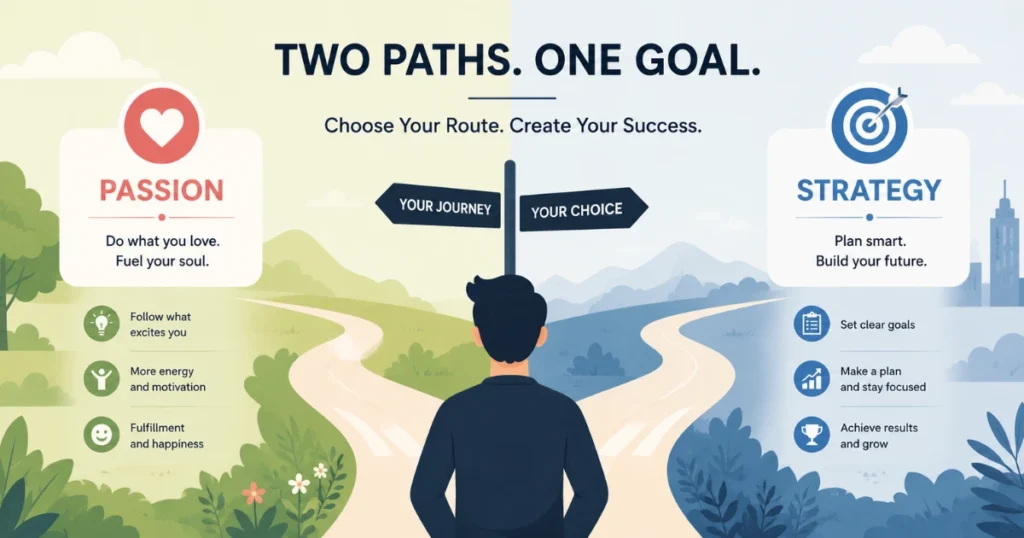
There’s a version of the “start a blog” story that gets told constantly online: write about your passion, post consistently, and the money will follow.
That’s half true and half recipe for disappointment.
Passion matters — you’ll burn out on a topic you don’t care about before the blog ever gains traction. But passion alone doesn’t make a blog profitable. What makes a blog profitable is an audience that needs specific information and products that solve their problems.
The successful bloggers I’ve studied — and there are a lot of them — didn’t just write about things they loved. They found the intersection of what they loved and what a specific group of people needed and were actively searching for.
Keep that frame in mind as we walk through each step.
Step 1: Choose a Niche That Has Both Passion and Potential
Your niche is the focused topic area your blog covers. “Everything that interests me” is not a niche. “Simple home cooking for busy parents” is a niche. “Freelancing tools and workflows for creative professionals” is a niche.
Why narrowness matters: A blog that tries to cover everything is trusted by no one in particular. A blog that covers one thing deeply becomes the go-to resource for that audience. That trust converts into loyal readers, email subscribers, and eventually paying customers or affiliate revenue.
How to evaluate a niche:
Ask yourself three questions:
- Could I write fifty different articles on this topic without running dry?
- Are there products, courses, or services people in this niche actively buy?
- Is there an audience actively searching for information on this topic?
If the answer to all three is yes — you have a viable niche.
A few niche examples with strong monetization potential:
- Personal finance for recent graduates
- Home organization for small spaces
- Remote work tools and productivity
- Plant-based cooking for beginners
- Travel planning on a budget
- Dog training for first-time owners
- Skincare routines for sensitive skin
- Learning a specific language as an adult
The mistake I made the first time: I chose “self-improvement” as my niche because it sounded meaningful. It’s also one of the most competitive, vague categories on the internet. Narrowing down to something like “productivity systems for freelancers” or “habit building for shift workers” would have given me a much clearer audience to write for.
Step 2: Set Up Your Blog the Right Way
You have two main options: free platforms or self-hosted.
Free platforms (WordPress.com, Blogger, Wix free tier): Easy to set up, no cost upfront, but you have limited customization, your blog lives on someone else’s domain (like yourblog.wordpress.com), and monetization options are restricted. Fine for experimenting, but not suitable for a blog you’re building seriously.
Self-hosted WordPress (WordPress.org): The standard for anyone serious about blogging. You own the domain, control everything, and have full monetization freedom. This is what I’d always recommend.
What you need for a self-hosted blog:
Domain name — your blog’s address (e.g., yourdomainname.com). Cost: around $10–$15/year through Namecheap or Google Domains.
Web hosting — the server that stores your site and makes it accessible online. Cost: $3–$10/month for beginner-level hosting.
Recommended hosting providers for beginners:
- Hostinger — consistently the best price-to-performance ratio I’ve seen for new bloggers ($2.99–$3.99/month with frequent sales)
- SiteGround — slightly more expensive but excellent support and reliability ($3.99/month on starter plan)
- Bluehost — popular beginner option, good WordPress integration ($2.95/month)
All three offer one-click WordPress installation. You set up an account, point your domain at your host, install WordPress, and your blog exists. The whole process takes about thirty minutes the first time.
Theme (design): For a new blog, use a free, lightweight theme. Astra and Kadence are both free, fast, and widely used. You don’t need a paid theme to start — the content matters far more than the design at this stage.
Essential plugins to install:
- Yoast SEO or Rank Math — helps you optimize posts for search
- Wordfence — basic security
- WP Super Cache or W3 Total Cache — improves site speed
- Akismet — spam comment filtering (free for personal use)
That’s genuinely all you need to get started. Don’t spend weeks customizing colors and fonts. Get the basics working and start writing.
Step 3: Plan Your Content Around What People Actually Search For
This is where most beginners go wrong — including me the first time.
They write whatever comes to mind and then wonder why nobody is reading it. The issue isn’t the writing quality. It’s that they’re not targeting topics people are actively searching for.
Search engine traffic is the lifeblood of most successful blogs. Unlike social media, where your post disappears after a day or two, a well-optimized blog post can drive traffic for years.
Keyword research for beginners:
A keyword is just the phrase someone types into Google. Your job is to write content that matches what real people are searching for.
Free tools to find keywords:
- Google itself — start typing your topic into Google and watch the autocomplete suggestions. These are real searches.
- AnswerThePublic (free limited searches) — shows you questions people ask around a topic
- Ubersuggest (free tier) — shows search volume and keyword difficulty
- Google Keyword Planner — free with a Google account, shows monthly search volume
- People Also Ask — the expandable questions inside Google search results. Every one of these is a blog post idea.
What to look for: Keywords with decent search volume (hundreds to thousands of monthly searches) and low-to-medium competition. As a new blog, you won’t rank for highly competitive terms — focus on specific, lower-competition phrases first.
Example of this in practice:
Instead of writing “How to Eat Healthy” (millions of search results, impossible to compete with), write “Easy Healthy Meal Prep for People Who Hate Cooking” (more specific, lower competition, still searched regularly).
Specificity consistently beats generality for new blogs trying to gain search traction.
Step 4: Write Content That Actually Gets Read
Good blog content isn’t about writing beautiful prose. It’s about being genuinely useful to a specific reader with a specific problem.
Structure of a post that works:
Opening: Start with the problem your reader has, not with an introduction about yourself or a definition. If your post is “How to Stop Procrastinating on Creative Work,” open with a situation your reader recognizes — not “Procrastination is defined as…”
Body: Break information into short sections with clear headings. Most blog readers scan before they read. If the headings tell the story, you’ll keep more readers engaged. Use bullet points and numbered lists where they serve the content, but don’t overdo it — text needs breathing room.
Closing: End with a clear takeaway or action step. Don’t just trail off. Tell the reader what to do next.
Length: There’s no perfect length, but most posts that rank well in search results are between 1,200 and 2,500 words. Longer posts rank better for competitive keywords — but only if the length is justified by actual useful content. Padding a post to 3,000 words with filler helps nobody.
Frequency: Two well-researched, genuinely useful posts per month is better than four rushed, shallow ones. Quality beats frequency. That said, consistency matters — a sporadic posting schedule makes it hard to build momentum.
AI in your writing workflow: Tools like Claude and ChatGPT are useful for outlining, drafting sections you’re stuck on, and repurposing content. Use them as thinking partners and writing accelerators — not as ghostwriters who produce content you publish unedited. The blogs that build real, loyal audiences are the ones where a human perspective comes through clearly.
Step 5: Build Your Email List From Post One
If I could go back and fix one mistake from my first blog, this is it.
I didn’t start building an email list until my second year of blogging. By the time I understood how important it was, I’d sent thousands of readers to posts without capturing any of them.
Your email list is the only part of your blog that can’t be taken away by an algorithm change. Google can stop ranking your posts. Pinterest can bury your pins. But if someone’s on your email list, you have a direct line to them forever.
How to build it from the start:
Create a simple lead magnet — a free resource that’s relevant to your niche and valuable enough that someone would give you their email to get it. Examples: a checklist, a one-page guide, a template, a recipe, a resource list.
Use ConvertKit (now called Kit) — their free plan is the best starting option for bloggers. Set up a simple opt-in form and embed it in your sidebar, at the bottom of posts, and in a popup (set to trigger after 30+ seconds so it’s not immediately annoying).
Then email your list regularly — even if it’s small. A list of 200 engaged subscribers is genuinely worth more than 10,000 cold visitors.
Step 6: Monetize — Here’s What Actually Works
Most beginner guides list every possible monetization method and leave you overwhelmed. I’ll focus on what works best at each stage.
Stage 1 (0–5,000 monthly visitors): Affiliate Marketing
This is your starting point. Find products and services relevant to your niche, join their affiliate programs, and recommend them naturally within your content.
Where to find programs:
- Amazon Associates — broad product coverage, low commissions (1–10%)
- ShareASale — huge network, programs across every niche
- Impact — more premium brands
- Direct programs — most software tools, courses, and subscription services have their own affiliate programs. Check their website footer.
What to look for: products you’d recommend even without the commission, reasonable commission rates, and ideally recurring commissions for subscription products.
A post that generates ten affiliate sales per month at $15 commission each is $150/month — from a piece of content you wrote once.
Stage 2 (5,000–20,000 monthly visitors): Display Ads
Once your traffic grows enough, adding display ads through Ezoic (lower traffic threshold, works with smaller blogs) or working toward Mediavine (requires 50,000 sessions/month) creates passive income that runs in the background.
Google AdSense is an option but pays significantly less than Mediavine or Raptive. Worth adding early for a small income stream, but not the main strategy.
Realistic display ad income: At 10,000 monthly visitors, you might earn $30–$80/month from ads depending on your niche. Not significant alone, but it adds up as traffic grows.
Related: AdSense Approval Tips for New Bloggers
Stage 3 (Growing audience): Digital Products
Once you understand your audience well — what they’re struggling with, what they’re searching for, what they’d pay to have solved — you can create a digital product specifically for them.
This is where blog income can shift significantly. A $27 digital product selling twenty times a month from your blog’s organic traffic is $540/month from an audience you’ve built.
Product ideas that work for most niches: PDF guides, templates, printables, mini courses, resource bundles, prompt packs.
Use Gumroad (free to start, ~10% fee) or Payhip (free, 5% fee) to sell and deliver products without building any technical infrastructure.
Stage 4 (Established audience): Sponsored Content and Premium Products
Brands in your niche will start reaching out once your blog has clear authority and consistent traffic. Sponsored posts (where a brand pays you to feature them) can pay $150–$1,500+ per post depending on your audience size and niche.
Premium products — courses, memberships, coaching — have the highest income ceiling of any monetization method, but they require a genuinely engaged audience first.
Related: Best Blogging Platforms
The Content Calendar: A Simple System That Keeps You Consistent
One of the main reasons blogs stall out is inconsistency. Life gets busy, motivation dips, and suddenly three months have passed without a post.
A simple content calendar prevents this.
Here’s what mine looks like: a Google Sheet with four columns — post title, target keyword, publication date, and status (idea / in progress / published). I plan one month ahead and maintain a running list of ideas in a fifth column.
On the first of every month, I plan the next month’s posts based on keywords I’ve researched and topics I’ve seen interest in from readers. I write them in the middle two weeks and publish in the final week.
Simple. Not glamorous. Works.
Mistakes That Killed My First Blog (And What I Changed)
Writing about everything instead of one focused thing. My first blog had posts about productivity, travel, food, and career advice. No clear audience, no clear purpose, no reason for anyone to become a loyal reader.
Ignoring SEO completely. I wrote what I felt like writing and published it. No keyword research, no on-page optimization, no understanding of why some posts would rank and others wouldn’t. The result: traffic that was almost entirely dependent on sharing, which stopped the moment I stopped sharing.
Not starting an email list. I mentioned this earlier but it bears repeating. Start the list on day one. Even if you don’t email anyone for months, capture those early readers.
Expecting results too quickly. My first blog was “failing” after six months. In reality, six months is nothing for a blog. Most blogs need twelve to eighteen months of consistent effort before search traffic compounds meaningfully. The blogs that succeed are the ones that keep going past the point where it feels like nothing is happening.
Publishing and disappearing. Writing a post and doing nothing to promote it is like printing flyers and keeping them in a drawer. Share new posts in relevant communities, on social media, to your email list. Each post should be actively distributed at launch, even if it will eventually get organic traffic from search.
Realistic Income Timeline for Bloggers
I want to be honest here because unrealistic expectations are what cause most people to quit right before their blog would have worked.
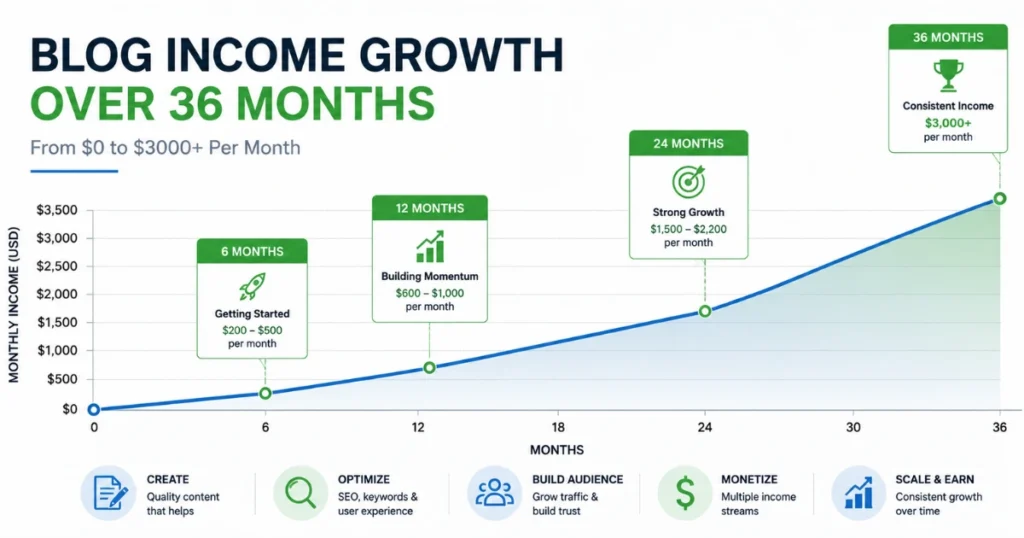
Months 1–3: Building content and establishing the blog. Traffic: minimal. Income: $0–$10 (maybe a few affiliate clicks if you’re lucky).
Months 4–6: Growing content library, beginning to see some organic traffic from older posts. Income: $10–$50/month from early affiliate commissions.
Months 7–12: Organic traffic starting to compound. Email list growing. First consistent affiliate income. Income: $50–$300/month.
Year 2: Blog reaching 5,000–15,000 monthly visitors if content has been consistent and SEO-focused. Display ads added. Digital product possible. Income: $200–$800/month.
Year 3+: Established authority, growing traffic, multiple income streams. Income: $500–$3,000+/month for many bloggers in good niches.
These are genuine ranges — not the highlight reel. Niches, consistency, quality, and a bit of timing luck all affect where you land within these ranges.
What to Do This Week to Get Started
Day 1: Choose your niche. Write down three topics and pick the one that satisfies all three questions: fifty articles possible, monetizable, people searching.
Day 2: Register a domain name ($10–$15 on Namecheap) and set up hosting (Hostinger or SiteGround). Install WordPress.
Day 3: Install a free theme (Astra or Kadence) and the four plugins listed above.
Day 4: Do keyword research for your first ten post ideas. Use Google autocomplete and AnswerThePublic.
Day 5: Set up a free ConvertKit account and create a simple lead magnet relevant to your niche.
Week 2: Write and publish your first post. It doesn’t have to be perfect. Done beats perfect at this stage.
Closing Thoughts

Blog number one was a lesson in everything not to do. Blog number two — started with a clearer head, a specific niche, basic SEO knowledge, and a real monetization plan — became something I’m genuinely proud of and that generates real income.
The difference wasn’t having more time or more writing talent. It was knowing which things actually matter and in what order to do them.
Start with a focused niche. Build a real website. Write for search. Collect emails from day one. Monetize as your audience grows.
That’s the path. It’s not fast. But it works.
FAQs
How much does it cost to start a blog?
A domain ($10–$15/year) and basic hosting ($35–$50/year for a starter plan) are the only essential upfront costs. Free tools handle everything else. You can start a self-hosted WordPress blog for under $60/year total.
How long does it take a blog to make money?
Most bloggers see their first meaningful income between months 6–12. Consistent, compounding income typically develops in year two. Anyone promising significant income in the first few months is overpromising.
Do I need to be an expert to blog?
Not a formal expert — but you need to know more than your reader about the topic, or be willing to research thoroughly enough to provide genuine value. The blogs that build audiences are ones where the author clearly understands what they’re writing about.
Is blogging saturated in 2026?
The generic, shallow-content approach is saturated. Specific, authoritative, genuinely helpful content in focused niches is not. Google’s quality-focused updates have actually created more opportunity for real, human-written content by filtering out low-quality sites.
What’s the best niche for a profitable blog?
Finance, health, and technology have the highest monetization potential but also the most competition. Better advice for beginners: pick a niche you genuinely care about within those categories, or find a mid-competition niche with strong affiliate opportunities where your genuine interest gives you a natural edge over people just chasing money.