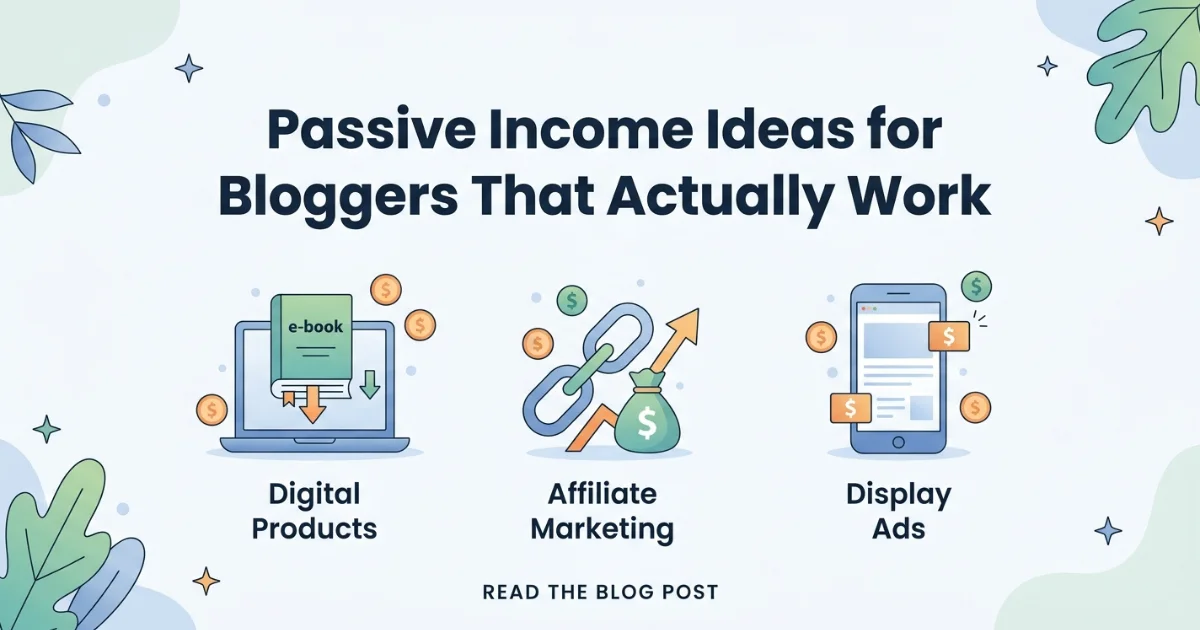
Let me tell you what passive income actually felt like the first time it happened to me.
It wasn’t exciting. I didn’t wake up to thousands of dollars. I opened my phone on a Saturday morning, still half asleep, and saw a $17 Gumroad notification for a template I’d made six weeks earlier. I hadn’t thought about that template in at least three weeks. It just… sold. While I was watching Netflix the night before, apparently.

That’s it. That’s the whole story. Seventeen dollars I didn’t work for that day.
But it changed how I thought about money — specifically, the idea that you can build things that continue generating income after the work is done. Not forever, not without any maintenance, and not without real effort upfront. But genuinely, meaningfully, without requiring your direct time.
The problem is that “passive income” has become one of those phrases that attracts more mythology than reality. Most of what gets marketed as passive income either takes enormous upfront capital (real estate), years of consistent work before paying anything meaningful (most blogs), or is essentially not passive at all (dropshipping with constant supplier management).
This list is different. It’s the ten I’d recommend to a friend — ordered from quickest to get going to longest runway — with honest notes on what each requires and what you can realistically expect.
The Truth About Passive Income (Before We Get Into the List)
Here’s the thing I wish every “passive income” article said upfront:
There is no such thing as income that requires zero work.
What passive income actually means is: income that isn’t directly proportional to your hours. You work hard upfront to build something, and then that thing continues generating returns while your active involvement decreases.
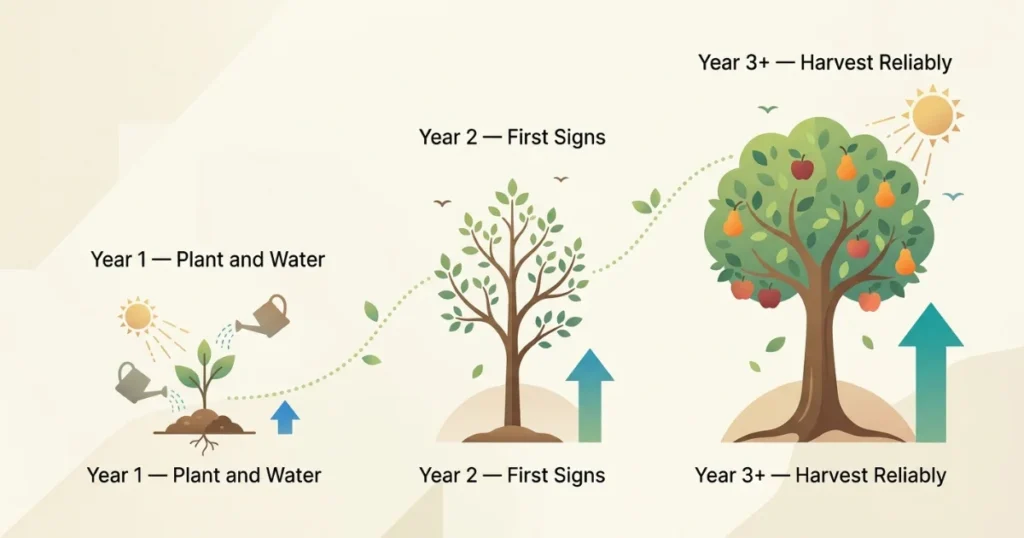
Think of it like planting fruit trees. Planting takes real effort. The first two years, you get little to nothing. By year three, you’re harvesting something meaningful. By year five, the trees are producing reliably with occasional maintenance.
That’s passive income. Not “do nothing, earn forever.” Build once, earn repeatedly with decreasing effort over time.
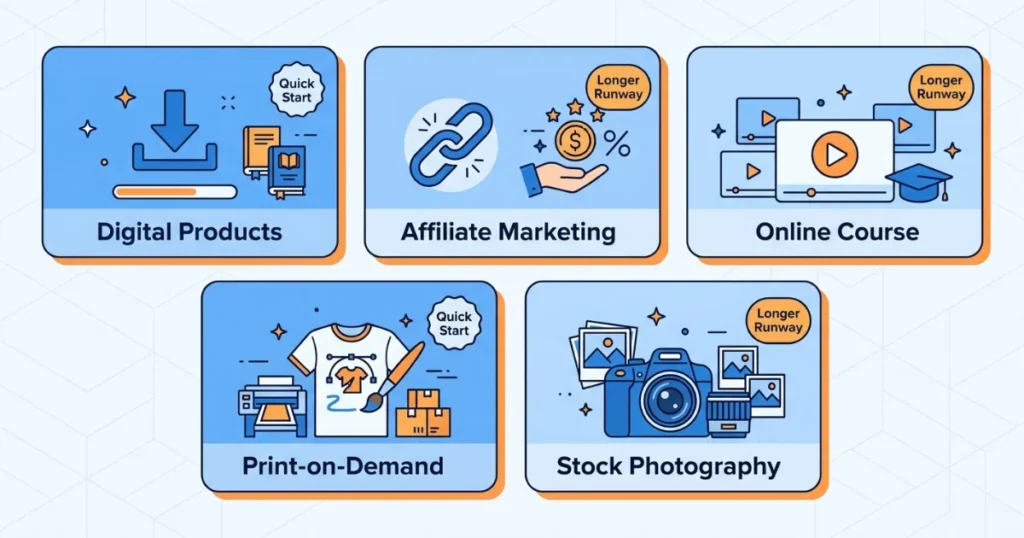
Every item on this list follows that model. Some have short runway (you can start earning within weeks). Some have long runway (months to a year before meaningful income). All of them are real.
READ MORE: Smart Ways to Earn Extra Income as a Blogger
1. Digital Products on Gumroad or Etsy
What it is: You create a downloadable product — an ebook, template, checklist, planner, prompt pack, Canva template, or study guide — and sell it through a platform that handles payment and delivery automatically.
Why it’s genuinely passive: Once the product is built and listed, every sale happens without your involvement. The platform collects payment, delivers the file, sends the receipt, and deposits money in your account.
What you actually need to start: A product idea, Canva (free) or Google Docs to create it, and a free Gumroad or Etsy account.
What it realistically earns: A well-targeted product at $12–$25 generating ten to thirty sales per month returns $120–$750/month. Multiple products compound this significantly.
Honest setup time: One to two focused weekends to create and list your first product. Traffic takes longer to build — Pinterest and SEO content are the best free sources.
Real example: A freelancer I know created a “Client Onboarding Template Pack” in a Saturday afternoon. It now generates around $200/month from Etsy organic search — work she did once, eighteen months ago.
2. Affiliate Marketing Through a Blog or YouTube Channel
What it is: You recommend products through content — blog posts, YouTube videos, newsletters — and earn a commission each time someone buys through your link.
Why it’s passive: A blog post written in 2023 can still drive affiliate commissions in 2026 if it ranks in Google. A YouTube tutorial published a year ago keeps earning commissions from every new viewer.
What you need to start: A platform (blog or YouTube), an affiliate program account (Amazon Associates, ShareASale, or brand-direct programs), and content people are searching for.
What it realistically earns: Variable, but once a blog or channel has meaningful organic traffic, affiliate income typically runs $200–$1,500/month for a mid-size site. High-ticket affiliate products (commissions of $100–$500 per sale) change the math significantly.
Honest timeline: This is one of the longer-runway options — typically six to twelve months before search traffic compounds meaningfully. But the income, once established, is among the most durable on this list.
Key move: Focus on evergreen content (information that stays relevant over time) and products with recurring commissions (software subscriptions that pay you every month a customer stays).
READ MORE: What Is Affiliate Marketing? Beginner Guide + High-Ticket Strategy
3. Selling an Online Course
What it is: You teach what you know — a skill, a system, a process — in a structured video or written format, and students pay once for lifetime access.
Why it’s passive: You record the course once. Students enroll and complete it on their own schedule. You’re not teaching live every time.
What you need to start: Knowledge worth teaching, a platform (Teachable, Podia, or Gumroad for simpler courses), and a way to drive people to it (email list, blog, YouTube, or social media).
What it realistically earns: Courses priced at $47–$197 can generate $500–$3,000/month once you have consistent traffic. Higher-priced courses ($297–$997) need fewer sales for the same revenue.
Honest caveat: Course income isn’t passive without an audience. The course itself is passive — but you need a way for people to find it. Building that audience (even a small email list) is the non-passive work that makes the passive part function.
Tool worth knowing: Loom (free tier) is excellent for recording course videos without expensive equipment. Your phone camera and natural window light work fine for most formats.
4. Print-on-Demand (T-Shirts, Mugs, Prints)
What it is: You upload designs to platforms like Redbubble, Printify (paired with an Etsy store), or Merch by Amazon. When someone orders a product, the platform prints it, ships it, and handles customer service. You earn the margin.
Why it’s passive: Zero inventory. Zero upfront cost. Zero fulfillment. You earn a small amount per sale indefinitely.
What you need to start: Designs (created in Canva, or with AI tools like Midjourney), a free account on Redbubble or Printify, and time to upload consistently.
What it realistically earns: Most people earn $50–$300/month from a moderately sized print-on-demand shop. Sellers with large catalogs of well-targeted designs earn significantly more — some in the thousands per month.
The niche insight that matters most: Generic designs (motivational quotes, basic animals) are swamped with competition. Specific niches — “Retired Teacher Humor,” “Border Collie Mom,” “Civil Engineer Life” — have dedicated buyers and far less competition.
AI advantage here: Midjourney and Adobe Firefly can generate design concepts in minutes, significantly accelerating how quickly you can build a catalog.
5. Licensing Your Photography or Digital Art
What it is: You upload photos or digital artwork to stock platforms like Adobe Stock, Shutterstock, Getty Images, or Alamy, and earn a royalty every time someone licenses your work.
Why it’s passive: You upload once. Every license paid by every user anywhere in the world earns you a percentage — repeatedly, indefinitely.
What you need to start: Quality images or digital art and approved accounts on your chosen platforms. Approval processes vary — Adobe Stock is generally easier for beginners than Getty.
What it realistically earns: Individual royalties are small (often $0.25–$2 per download), but a large library of in-demand images compounds. Photographers with 500–1,000 images on multiple platforms often earn $200–$800/month. Niche subjects (specific business scenarios, diverse people, specific locations) sell better than generic landscapes.
Honest note: AI-generated images have a complicated relationship with stock platforms — each platform has different policies on AI content. Check current guidelines before submitting AI-generated work.
6. Creating a Niche YouTube Channel
What it is: You build a YouTube channel focused on a specific topic, grow an audience over time, and earn through YouTube’s ad revenue, affiliate links in descriptions, and eventually channel memberships or product sales.
Why it qualifies as passive (eventually): Old videos keep earning. A tutorial you uploaded fourteen months ago still gets views and generates affiliate commissions or ad revenue today.
What you need to start: A topic with an audience, a phone camera, a free editing app (CapCut works well), and consistency.
What it realistically earns: Pre-monetization (before 1,000 subscribers and 4,000 watch hours): $0 from ads, but affiliate links work from day one. Post-monetization: $1–$20 per 1,000 views depending on niche. Finance and business channels earn significantly more per view than entertainment channels.
Honest timeline: This is the longest runway on the list. Most channels take eight to eighteen months of consistent publishing before meaningful ad revenue. The people who succeed are the ones who don’t treat the first year as a failure because it doesn’t pay immediately.
What makes channels grow faster: Searchable content (tutorials, reviews, “how to” videos) rather than just entertaining content. YouTube’s search function drives consistent, long-term discovery.
7. Self-Publishing Books on Amazon KDP
What it is: You write and publish ebooks or print-on-demand paperbacks through Amazon’s Kindle Direct Publishing. Amazon sells them; you earn royalties.
Why it’s passive: Once published, your book is available to Amazon’s entire customer base indefinitely. You earn 35–70% royalties on every sale without any fulfillment work.
What you need to start: Content worth publishing (knowledge, fiction, or low-content books like journals and planners), a free KDP account, and a cover (Canva works well for this).
Two very different approaches:
Content books (non-fiction guides, how-to books): Require real knowledge and solid writing. Priced $5–$15 for ebooks. A well-positioned non-fiction book in a specific niche can earn $100–$500+/month.
Low-content books (journals, planners, trackers, activity books): Require minimal writing — mostly interior design and targeted niche selection. More competitive than a few years ago, but specific niches still work well.
AI’s role: Claude or ChatGPT can help you outline, structure, and draft content significantly faster. Use them to accelerate production while keeping your expertise and judgment as the editorial layer.
8. Building a Niche Blog With Display Ads
What it is: You build a blog focused on a specific topic, grow organic search traffic through SEO content, and earn through display advertising programs (Ezoic, Mediavine, or Google AdSense).
Why it’s passive: Every page view generates a small amount of ad revenue automatically, with no action required from you. An article published two years ago still earns ad revenue today if it continues receiving traffic.
What it realistically earns: Display ad income depends heavily on niche and traffic. Personal finance and health blogs earn $15–$25 per thousand visitors. Lifestyle blogs might earn $6–$12 per thousand. At 20,000 monthly visitors: $120–$500/month from ads alone. Paired with affiliate income, this compounds significantly.
Thresholds worth knowing:
- Google AdSense: No minimum traffic requirement, but very low RPM (revenue per thousand visitors)
- Ezoic: Works with smaller sites (under 10,000 visitors), pays better than AdSense
- Mediavine: Requires 50,000 sessions/month, pays significantly more
- Raptive (formerly AdThrive): Requires 100,000 monthly visitors, highest RPM
Honest timeline: Same as YouTube — 6–18 months before meaningful traffic from search. This is a long-game investment.
Related: Start a Blog and Make Money From It
9. Peer-to-Peer Lending and High-Yield Savings
What it is: You put money into financial instruments that generate interest over time — high-yield savings accounts, money market accounts, or P2P lending platforms — and earn returns without active work.
Why it’s passive: Interest accrues automatically. You do nothing after the initial deposit.
What it realistically earns: High-yield savings accounts in 2026 offer around 4–5% APY at competitive institutions (check current rates at nerdwallet.com or bankrate.com). On $10,000, that’s $400–$500/year — not life-changing, but genuinely zero-effort income.
P2P lending (platforms like LendingClub) offers higher potential returns (6–12%) but with higher risk — some loans default. This is appropriate only for money you can afford to have at risk.
Important note: This is the only item on this list that requires capital to start, and returns are proportional to the amount invested. This is a supplement to other income strategies, not a standalone approach for most people without significant savings.
10. Creating an Email Newsletter With Paid Sponsorships
What it is: You build an email newsletter around a specific topic or audience, grow a subscriber base, and sell advertising space to brands who want to reach your readers.
Why it qualifies as (somewhat) passive: Once the newsletter has a sponsor structure in place, the income from each issue doesn’t require additional client acquisition work — brands buy recurring placements.
What you need to start: A niche topic with a targeted audience, a free ConvertKit or beehiiv account, and consistency in publishing.
What it realistically earns: Newsletter sponsorship rates are typically $25–$50 per thousand subscribers per issue (CPM). A newsletter with 5,000 engaged subscribers can command $125–$250 per sponsored placement. At two sponsors per issue and weekly publishing, that’s $1,000–$2,000/month.
Honest caveat: Getting to 5,000 subscribers takes real work — consistent publishing, list-building promotion, and genuinely valuable content over time. But the combination of paid sponsorships and occasional affiliate links in newsletters has made it one of the higher-income-per-subscriber channels available.
Platform worth knowing: beehiiv has a built-in ad network that matches newsletters to sponsors automatically — removing the need to pitch brands yourself once your newsletter reaches a certain size.
How to Choose Where to Start
Ten options is ten too many if you try to start all of them simultaneously.
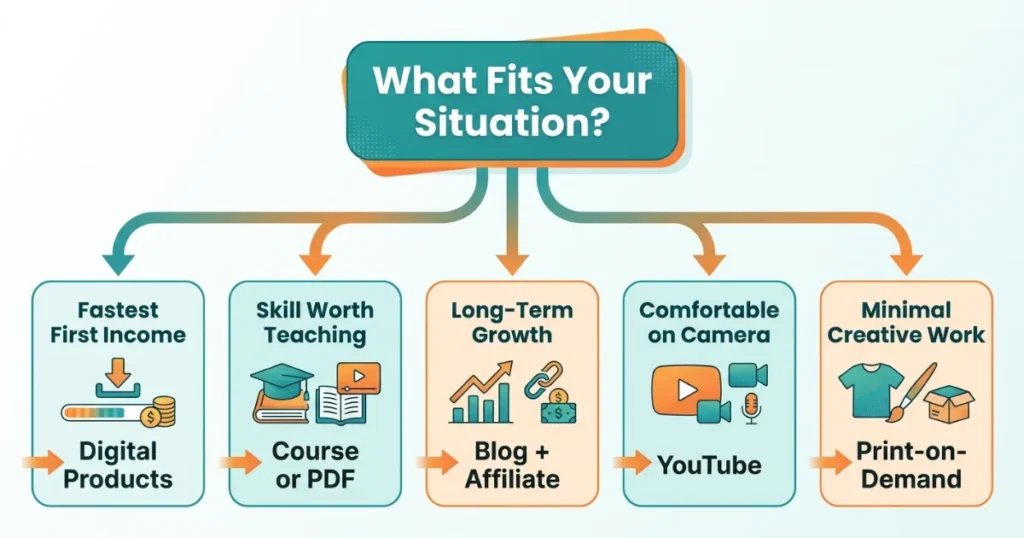
Here’s the framework I’d use:
If you want the fastest path to any passive income: → Digital products on Gumroad or Etsy. Build one thing this weekend. List it. Promote it on Pinterest. It can sell within days.
If you have a skill or knowledge worth teaching: → Digital product or online course. Package it. The packaging takes one to two weeks; the income compounds from there.
If you want the most durable, long-term income: → Blog + affiliate marketing + email list. Slow start, powerful compound growth.
If you’re a creator comfortable on camera: → YouTube channel. Longest runway, but content compounds better than almost anything else.
If you want passive income with minimal creative work: → Print-on-demand designs or stock photography. Lower ceiling, lower effort.
If you already have savings: → High-yield savings account. Zero effort, moderate return, genuinely passive from day one.
Pick one. Not two or three — one. Give it three to six months of real effort. That timeline is what separates the people who build passive income from the people who try several things and quit each before it works.
Mistakes That Keep “Passive Income” From Ever Becoming Passive
Treating the setup phase as passive. The first three months of almost any passive income stream involve active, concentrated work. Expecting it to be easy from day one leads to early abandonment.
Giving up before the compound effect kicks in. This is the most common reason passive income attempts fail. The blog at month three looks like a waste of time. The blog at month eighteen is making $500/month while you sleep. The difference is staying in long enough.
Building without an audience. Products without traffic, courses without email lists, YouTube channels without subscriber strategies — they don’t become passive because there’s nobody buying. Building the audience in parallel with the product is essential.
Spreading across too many streams at once. Five passive income streams each getting 20% of your attention won’t generate the momentum that one stream getting 100% of your attention would. Depth first, breadth later.
Confusing “someday passive” with “passive now.” None of these are passive on day one. They become passive over time, as the foundation compounds. Starting with the expectation that passive income means immediate ease is how people burn out and call the whole thing a scam.
A Realistic Snapshot of What This Can Build
Let me paint a picture of what several streams working together can look like after two or three years — not immediately, but as a realistic horizon:
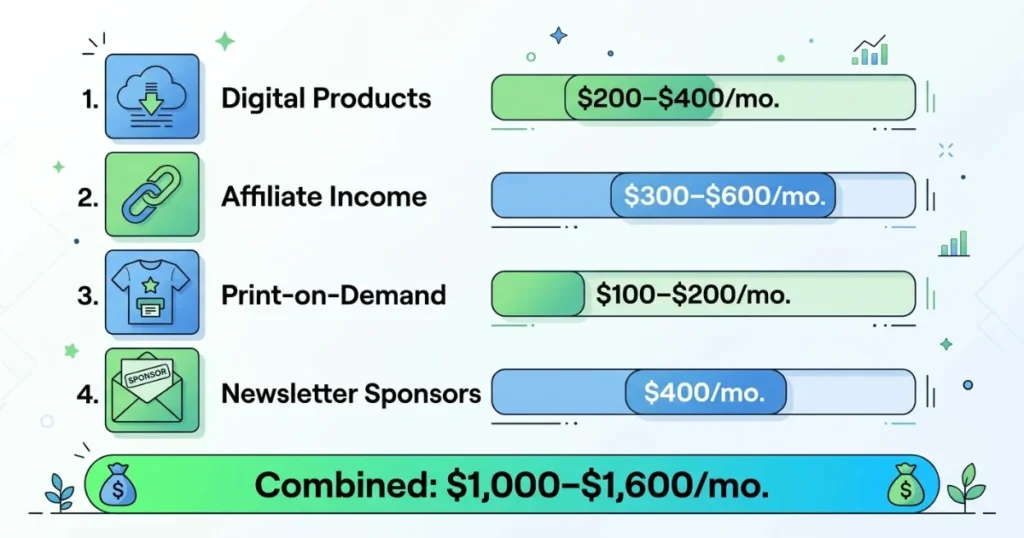
- Digital products generating $200–$400/month from Etsy and Gumroad
- Affiliate income from a modest blog generating $300–$600/month
- Print-on-demand designs earning $100–$200/month
- A small newsletter with two sponsors per issue earning $400/month
Total: $1,000–$1,600/month from income streams that require a few hours of weekly maintenance rather than a second job.
That’s achievable for most people who commit to the build phase and don’t quit when it takes longer than they expected.
FAQs
What passive income idea makes money the fastest?
Digital products (Gumroad or Etsy) can generate your first sale within days of launching if you promote the product actively. Print-on-demand platforms like Redbubble don’t require any promotional effort but take longer to get organic discovery.
Can you build passive income with no money?
Most of the items on this list have a free starting path: Gumroad and Etsy have free accounts, YouTube and blogging can start on free platforms, Redbubble costs nothing to join. The exception is savings account income, which requires capital. A domain and hosting ($50–$80/year) is the only meaningful cost for most approaches.
Is passive income taxable?
Yes. In virtually every country, income is income regardless of how you earned it. Digital product sales, affiliate commissions, ad revenue, and royalties are all taxable income. Keep records and consult your country’s tax guidance or an accountant once your income reaches meaningful levels.
Which passive income ideas work best for beginners?
Digital products and print-on-demand have the lowest barrier to entry. Both can be started with no prior experience, free tools, and a few days of setup time.
How much can I realistically earn from passive income in the first year?
For most people who start from zero and are consistent: $50–$300/month from passive income sources by the end of year one is a realistic honest target. Year two, with compounding, often looks significantly different. Anyone promising thousands per month in year one without significant effort or capital is overpromising.