The first affiliate commission I ever earned was $4.20.
I’d written a blog post about a productivity app I genuinely used, dropped my affiliate link in the middle of it, and forgot about the whole thing for about three weeks. Then I opened my email one afternoon and saw a commission notification.

Four dollars and twenty cents.
I’m not going to pretend that was life-changing. But what it was — and this is the part I couldn’t shake — was money I made while I was doing something else entirely. I hadn’t taken a meeting. I hadn’t sent an invoice. I hadn’t done anything that day. Someone read a post I’d already written, clicked a link, bought the app, and I got a cut.
That tiny amount cracked something open in how I thought about earning online.
Over the next year, I went from $4.20 to a few hundred dollars a month from affiliate income. Not from working harder, but from understanding how the model actually works and being more intentional about what I promoted, how I promoted it, and who I was talking to.
This guide covers everything I wish I’d understood from the start — including the high-ticket strategy that, once I figured it out, changed the math entirely.
What Affiliate Marketing Actually Is (Explained Without the Jargon)
Here’s the simplest way I’ve found to explain affiliate marketing:
You recommend a product. Someone buys it through your recommendation. The company pays you a percentage of that sale.
That’s genuinely it.
You don’t own the product. You don’t deal with customer service, refunds, inventory, or shipping. You’re the middleman — the trusted voice that points someone toward something they were probably already looking for. In exchange, you get a commission.
The mechanics work through affiliate links — unique URLs that track which sales came from your recommendation. When someone clicks your link and makes a purchase (usually within a set window of time, like 30 or 60 days), the sale gets attributed to you and the commission is added to your account.
A concrete example:
Let’s say you write a blog post about your favorite email marketing tool. You join that company’s affiliate program, they give you a unique link, and you include it in the post. A reader finds your post, clicks your link, and signs up for a paid plan. The company pays you a commission — maybe 20% of the monthly subscription, every month that reader stays subscribed.
If that tool costs $50/month and you referred ten paying subscribers, that’s $100/month recurring. Just from that one post.
That’s the model. Now let’s talk about how it actually gets built.
The Four Pieces of Every Affiliate Marketing Setup
Understanding these four components makes the whole thing less mysterious:
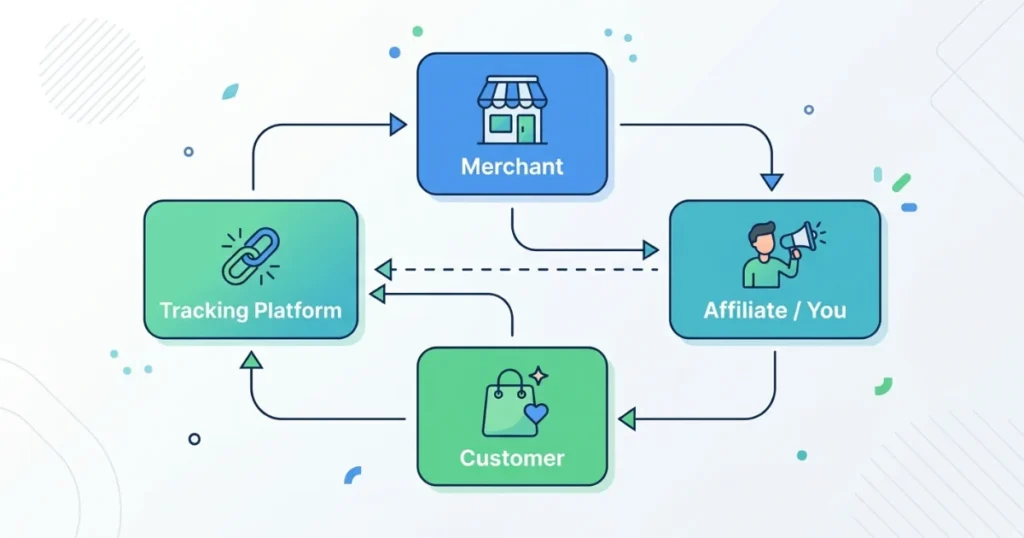
- The merchant — the company selling the product. They create the affiliate program, set the commission rate, and pay you when you drive sales.
- The affiliate — that’s you. You recommend the product through your content, links, email list, or social media.
- The customer — the person who finds your recommendation, clicks your link, and buys.
- The platform or network — the system that tracks clicks and sales and ensures you get paid. Some merchants run their own affiliate programs directly. Others use networks like ShareASale, Impact, or PartnerStack that manage affiliates for multiple companies at once.
You’ll interact with all four of these. The merchant sets your commission rate. The customer responds to your content. The platform tracks and pays you. Your job is to be the bridge between the customer and the product — in a way that’s honest and genuinely helpful.
That last part is more important than most beginner guides acknowledge.
READ MORE: Best Skills to Learn for Blogging
How to Actually Start: Step-by-Step
Step 1: Choose a Niche
Affiliate marketing without a niche is like shouting into a crowd. Affiliate marketing with a specific niche is like having a conversation with the exact person who needs what you’re recommending.
Your niche should sit at the intersection of:
- Something you genuinely know or care about
- An audience that has money to spend on solutions
- Products with actual affiliate programs
Good beginner-friendly niches with strong affiliate opportunities: personal finance, software tools (especially SaaS), health and wellness, home office and productivity, online education, career development, parenting, and pet care.
The niche mistake I made: I started with “productivity” as my niche — which sounds specific but is actually enormous. Everything from time management apps to sleep aids could fit under “productivity.” I got more traction when I narrowed down to “productivity tools and workflows for freelance writers.” Smaller audience, more relevant products, higher conversion rate.
Step 2: Pick Your Traffic Channel
Affiliate links need traffic. Without people clicking them, nothing happens. Your traffic channel is where you’ll build your audience.
Options:
Blog/website — the most durable traffic source. SEO content drives visitors for years after you publish. Slower to build, but compounds significantly. Free hosting options exist (WordPress.com, Wix), but a self-hosted site on SiteGround or Hostinger ($3–$6/month) gives you more control.
YouTube — video reviews, tutorials, and comparisons convert exceptionally well for affiliate products. People watching a software tutorial are close to a purchase decision. Second-best long-term traffic source.
Email list — the channel you own. No algorithm changes affect it. An email with a genuine recommendation to 500 engaged subscribers regularly converts better than a blog post with 5,000 monthly visitors.
Pinterest — works particularly well for product-heavy niches like home, lifestyle, health, and education. Pins drive traffic for months or years.
Social media (TikTok, Instagram, LinkedIn) — fastest to build an audience, but the most volatile. Algorithm-dependent and not ideal as a primary affiliate channel without a backup.
I’d pick one channel, get traction there, and add a second only once the first is consistently generating traffic.
READ MORE: Start a Blog and Make Money From It
Step 3: Join Affiliate Programs
Once you know your niche and traffic channel, find products to promote.
Where to find affiliate programs:
- Amazon Associates — low commissions (1–10% depending on category) but enormous product selection. Good starting point for product-review content.
- ShareASale — thousands of brands and merchants across virtually every niche. Easy approval for most programs.
- Impact — similar to ShareASale, slightly more enterprise-focused brands.
- PartnerStack — specialized in SaaS (software) products. Great if your niche involves any digital tools.
- Direct programs — many companies run their own programs. Canva, ConvertKit, Notion, Grammarly, and most SaaS tools have affiliate programs you can find on their website (usually in the footer: “Affiliates” or “Partner Program”).
What to look for when evaluating a program:
- Commission rate (obviously)
- Cookie duration — how long after a click you get credit for a sale. 30 days is standard; 90 days or lifetime cookies are better.
- Recurring commissions — for subscription products, recurring commissions pay you every month a customer stays subscribed. These compound over time in a way one-time commissions don’t.
- Product quality — you’re staking your credibility on what you recommend. Promoting bad products might earn a short-term commission and permanently damage your audience’s trust.
Step 4: Create Content That Recommends Honestly
The content that converts best in affiliate marketing is content where the recommendation feels like it comes from a genuine place — because it does.
The formats that work:
Product reviews — honest assessment of a product you’ve used. What’s good, what’s not, who it’s for, who it isn’t for. The “cons” section of a review signals honesty and paradoxically increases trust and conversion.
Comparison posts — “X vs. Y: Which One Is Right For You?” These capture people who are already close to a purchase decision and just need help choosing between two options.
Tutorial content — “How to do [task] using [tool]” naturally integrates an affiliate recommendation within genuinely useful content.
Best-of lists — “Best tools for [specific use case]” round up multiple products with affiliate links, giving you multiple commission opportunities from a single piece of content.
Resource pages — a dedicated page on your site listing all the tools, products, and services you recommend, with affiliate links throughout. Visitors who trust you bookmark this and return to it.
The High-Ticket Strategy: Where the Real Income Shift Happens
Now here’s the part that took me too long to figure out.
For the first year, I focused almost entirely on low-ticket affiliate products — apps, small subscriptions, books. The commissions were real, but the math was hard. To earn $500/month from products paying $5–$10 per commission, you need fifty to a hundred sales every month. That requires significant traffic.
High-ticket affiliate marketing is fundamentally different.
A high-ticket affiliate product is one where the commission is large — typically $100 to $1,000+ per sale. One or two sales per month at that level generates meaningful income.
Examples of high-ticket affiliate programs:
- Software with high subscription value — enterprise-level project management, marketing platforms, and CRM tools often pay commissions of $100–$500+ per referral.
- Online courses and education — courses priced at $500–$2,000 typically pay 30–50% commissions. A $1,000 course at 40% commission pays you $400 per student you refer.
- Financial products — insurance, investment accounts, and credit cards sometimes pay $50–$200 per signup or funded account.
- Web hosting (competitive, but high commissions) — Kinsta, WP Engine, and similar premium hosting providers pay $50–$200+ per signup.
- Business software — HubSpot, SEMrush, and similar B2B tools pay significant commissions because their customer lifetime value justifies it.
- Masterminds and coaching programs — high-end education and coaching programs sometimes offer affiliate commissions of 20–40% on prices ranging from $1,000 to $10,000+.
How the math changes:
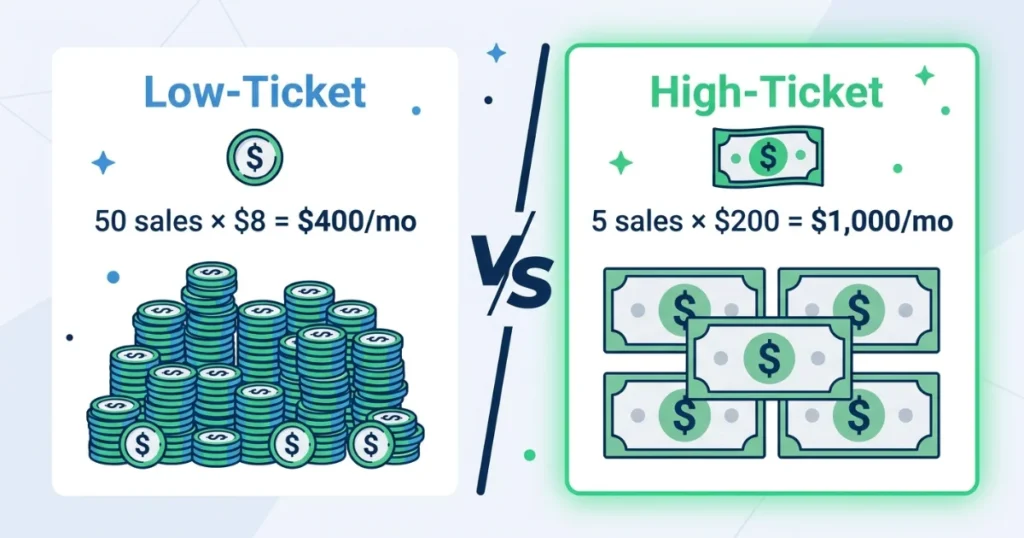
Low-ticket example: 50 sales/month × $8 commission = $400/month High-ticket example: 5 sales/month × $200 commission = $1,000/month
Same income. Ten times fewer sales needed.
That’s why experienced affiliate marketers spend time finding and building trust in high-ticket products — the volume requirement is dramatically lower.
The catch: High-ticket products require more trust from your audience before they’ll buy. Nobody spends $1,500 on a course because they saw one blog post. They spend it because they’ve read multiple pieces of your content, been on your email list, watched your YouTube videos, and feel confident that your recommendation comes from experience.
This means the high-ticket strategy pairs best with building a genuine, engaged audience over time — not quick wins from cold traffic.
READ MORE: Smart Ways to Earn Extra Income as a Blogger
Building Toward High-Ticket: A Practical Approach
Here’s how I’d structure this if I were starting fresh in 2026:
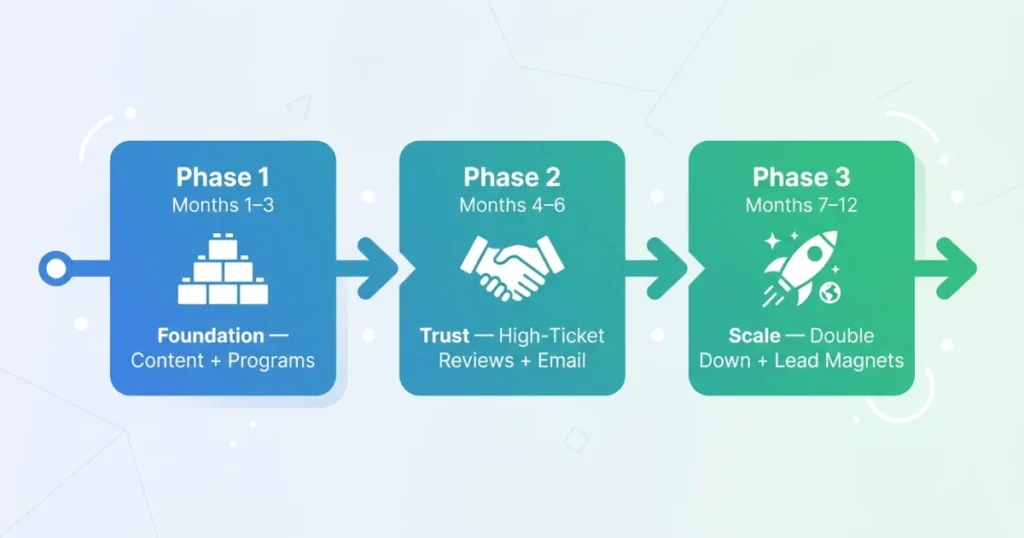
Months 1–3 (foundation):
- Build content in a focused niche
- Start with accessible affiliate programs (Amazon Associates, ShareASale brands) to learn how the tracking and reporting works
- Focus on building an email list from day one — even a tiny list of engaged subscribers is worth more than 10x the traffic from cold visitors
Months 4–6 (trust-building):
- Identify two or three high-quality, high-ticket products in your niche that you can genuinely recommend from experience
- Create in-depth reviews or tutorial content around these products
- Promote these through your email list where trust is highest
Months 7–12 (scaling):
- Double down on the content formats and products generating the most revenue
- Build out comparison and resource pages targeting high-intent search traffic
- Consider building a free lead magnet that naturally flows into your highest-converting recommendation
The timeline is slower than most affiliate marketing courses admit. But the income that builds from this approach is significantly more durable than the quick-win strategies that stop working the moment an algorithm changes.
Mistakes That Wasted My Time (And Money)
Promoting things I hadn’t used. Early on, I promoted a few tools I’d heard were popular without actually using them. The content was shallow, the recommendations felt hollow even to me, and the conversion rate was terrible. Every high-converting piece of affiliate content I’ve written has been about something I genuinely use.
Ignoring email. For eighteen months, I focused entirely on blog traffic and completely neglected building an email list. The list I should have been building from month one would have generated significantly more affiliate income than the cold traffic approach I relied on.
Promoting too many things at once. A resource page with forty affiliate links is not more valuable than one with eight carefully chosen ones. Readers see a list of forty links and feel like they’re being sold to. Eight well-explained recommendations read as curation.
Choosing products only based on commission rate. A 50% commission on a $10 product isn’t worth your audience’s trust if the product is mediocre. Always put product quality first. The long-term value of a trust relationship with your audience far exceeds any individual commission.
Not disclosing affiliate relationships. In most countries (including the US under FTC guidelines), you’re required to disclose when content contains affiliate links. This isn’t just legal compliance — it’s honest practice. Most readers respect transparency. A simple “This post contains affiliate links — I only recommend products I use and genuinely like” is all that’s needed.
The Income Picture: Honest Expectations
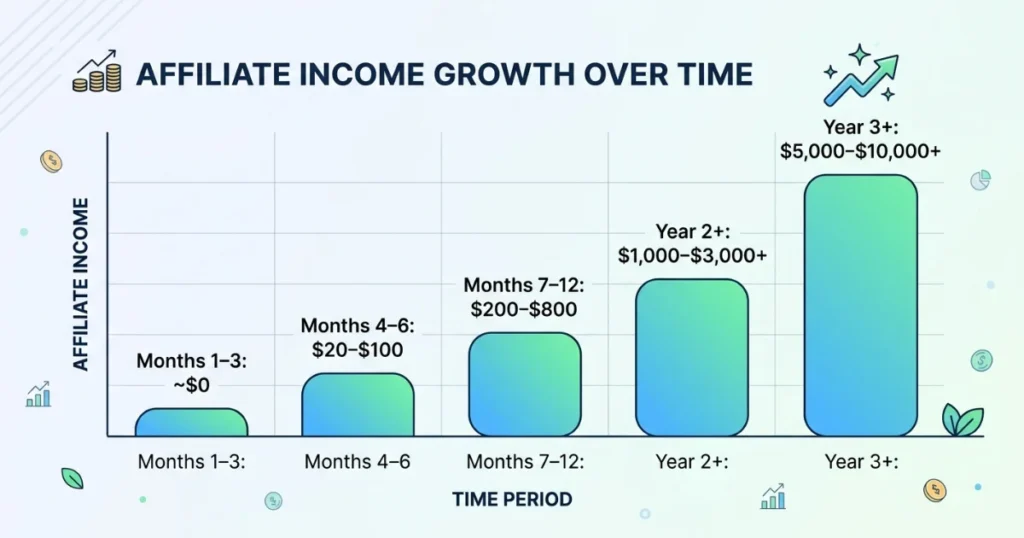
Months 1–3: Near zero. You’re building content, an audience, and trust. This phase is an investment.
Months 4–6: First consistent commissions, probably $20–$100/month from low-ticket products if you’ve been publishing and promoting consistently.
Months 7–12: With high-ticket products in the mix and a small email list, $200–$800/month becomes realistic for someone working part-time on this.
Year 2+: With a growing email list, consistent content output, and compounding SEO traffic, $1,000–$3,000+/month is achievable for a focused affiliate site. Some niches and approaches scale much higher.
These are honest ranges — not the $10,000/month in passive income claims that affiliate marketing courses sometimes dangle. Those outcomes exist for a small number of people who’ve spent years building. The ranges above represent what consistent, honest effort typically produces in the first one to two years.
READ MORE: AdSense Approval Tips for New Bloggers
Quick-Start Checklist
For anyone who wants to get started this week:
- Pick a niche (as narrow as you can reasonably go while still having products to promote)
- Choose one traffic channel to build first (blog, YouTube, or email list)
- Sign up for two or three affiliate programs relevant to your niche
- Create your first piece of genuinely useful content with an honest affiliate recommendation
- Start building an email list from day one — even a simple ConvertKit free account with a basic opt-in works
- Identify one high-ticket product in your niche to work toward recommending once your audience trusts you
FAQs
Do I need a website to do affiliate marketing?
Not strictly. Affiliate marketing can be done through email lists, YouTube channels, TikTok, or even Pinterest boards. But a self-hosted website gives you more control, better SEO opportunities, and a platform you own — which makes it the best long-term foundation.
How much does it cost to start affiliate marketing?
The honest minimum is the cost of a domain and hosting — roughly $30–$80/year. Free tools (WordPress, Canva, ConvertKit’s free tier) cover everything else. Some people start with zero dollars using free platforms, though the ceiling is lower.
Is affiliate marketing still viable in 2026?
Yes — but the approach that works has shifted. Content mills, thin review sites, and low-quality recommendation pages get filtered out by Google’s quality updates. What works in 2026 is genuine authority content, honest reviews, and audience relationships built around real trust.
What’s the best affiliate program for beginners?
Amazon Associates is the easiest to join and the broadest in product coverage — good for getting started and learning how tracking works. ShareASale and Impact give access to higher-commission programs as you grow.
How long before affiliate marketing generates consistent income?
For most people building honestly and consistently: 4–8 months before meaningful monthly income, 12–18 months before stable, predictable income. The people who give up at month three are stopping right before compounding starts.