
My second year of university, I had exactly Rs. 1,200 left before the month ended and three weeks still to go.
I wasn’t in some dramatic situation. My family wasn’t broke. I just wanted to stop asking for money every time I needed something — a laptop charger, a book, a dinner with friends that didn’t feel like a guilt trip. That feeling of financial dependence, even when people are happy to help, quietly wears on you.

So I started looking for ways to earn something online. I tried surveys (waste of time), GPT task sites (paid like $0.02 per task), and even tried reselling stuff I didn’t need. None of it added up.
What actually worked came from an unlikely direction: writing online, using AI smartly, and packaging what I already knew into something people would pay for.
This guide covers exactly that — the realistic, no-exaggeration ways students can earn money online in 2026. Not “earn $5,000 your first month” nonsense. Just what’s actually possible when you’re consistent, a bit patient, and willing to put in genuine effort.
Start a Blog — Still the Most Underrated Student Side Hustle

Every few months someone declares blogging dead. They’re wrong.
What’s dead is the lazy version of blogging — churning out generic posts, hoping Google sends you traffic for no effort. The blogs that are growing right now are specific, personal, and actually useful.
Students have a genuine advantage here that most people overlook: you’re surrounded by topics people search for. Study tips for a specific exam. How to survive your first year in a particular degree. Budget living in a specific city. Tools that helped you in your field. These are real search queries with real people behind them.
I started a small blog during my second year writing about productivity tools for students. Nothing fancy — just posts I wished existed when I was looking for help. Within five months it was getting around 4,000 visitors a month. Not huge, but enough to start earning from affiliate links.
Here’s how to get started without overcomplicating it:
- Pick a specific topic you know well and that has search demand. Use Google autocomplete — type a topic and see what questions people are asking. That’s your content calendar.
- Set up hosting and a domain — Hostinger and Namecheap are affordable for students (often under $2–3/month with student promos). WordPress is still the best CMS for long-term flexibility.
- Write your first five posts before you worry about design or SEO plugins. Content is the whole point.
- Install Rank Math or Yoast (both free) for basic on-page SEO guidance. Don’t obsess over it — write for humans first.
- Sign up for Google Search Console on day one. It’s free, shows you what people search to find your posts, and helps you improve.
READ MORE: How to Start a Blog and Make Money From It
When does the money come?
Honestly, months three to eight for most people — not weeks. Blog income builds through affiliate links (recommending tools relevant to your posts), Google AdSense (once traffic picks up), or even sponsored posts once you have a niche audience.
The mistake I made early: writing about topics that I found interesting but that nobody was searching for. Post six months of content, check what’s actually getting traffic, then write more of that.
Use AI Tools to Work 3x Faster (And Earn While You Do)

Here’s where 2026 is genuinely different from five years ago.
Students who understand how to use AI tools — not to cheat, but to work smarter — have a real advantage when it comes to earning online. The key word is “with,” not “instead of” your own thinking.
AI tools that actually help students earn:
ChatGPT (GPT-4o) — Brainstorm article ideas, create content outlines, edit your drafts for clarity, generate product descriptions, or script YouTube videos. A blog post that might take four hours now takes ninety minutes if you use it well for the outline and editing stages.
Claude (Anthropic) — Excellent for longer-form writing, nuanced editing, and research summaries. Useful if you’re offering writing services to clients.
Canva AI — Generate thumbnails, social media graphics, and template visuals in minutes. If you’re selling Canva templates (more on that below), the AI generation features help you move faster.
Notion AI — If you’re building and selling Notion templates, this helps you design the logic and structure quicker.
Perplexity — A research-first AI browser. Great for finding source-backed answers when you’re writing blog posts that need to be accurate.
READ MORE: Best AI Tools to Make Money Online
How students can earn specifically using AI:
- Offer AI-assisted content writing services on Contra or LinkedIn. Brands need blog content. You write it. AI helps you do it faster and refine it better. You charge for the quality, not the time.
- Create AI-assisted study guides for your specific course or exam — then sell them as PDFs.
- Build and sell prompt packs — Niche collections of tested prompts for specific uses (like “50 ChatGPT prompts for law students”). These sell well on Gumroad.
The important thing: AI is a tool, not the product. The product is still your knowledge, your judgment, your voice. AI just removes the friction.
Sell Digital Products — The Income That Doesn’t Need You to Show Up
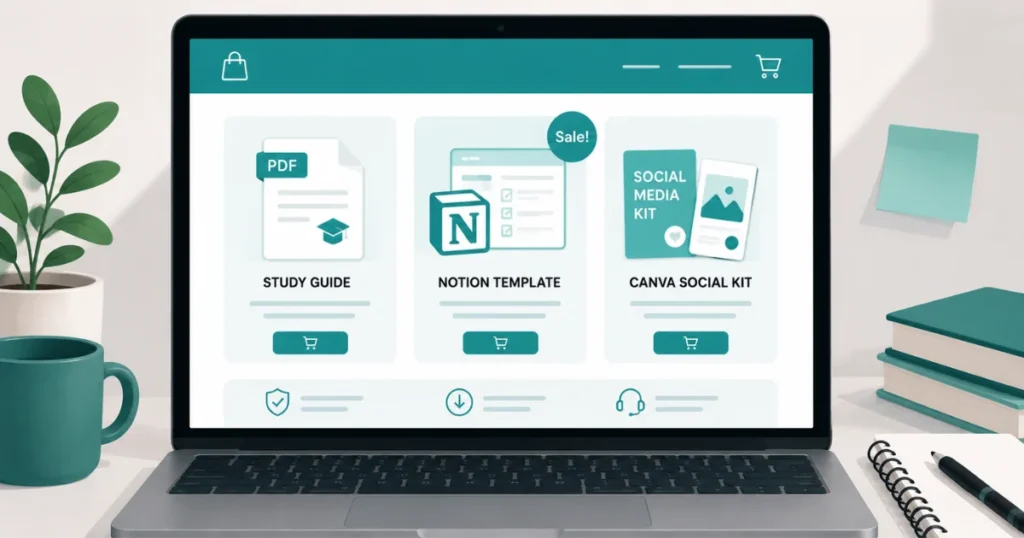
This is the one that surprised me most. The first time I sold something I’d made — a simple Notion study planner template — I remember staring at the Gumroad notification for about thirty seconds.
Someone I’d never met paid $11 for something I built in an afternoon.
Digital products don’t require inventory, shipping, or a big following. You build them once, and they sell whenever someone finds them. For students, the sweet spot is packaging knowledge or systems you already use.
Digital products students can create:
- Notion templates — Study planners, assignment trackers, reading logs, project managers. Students are Notion’s biggest user base. There’s constant demand.
- Canva templates — Social media post templates, resume designs, presentation decks, study flashcard designs.
- PDF guides and cheatsheets — “Everything I know about [specific subject]” sold as a structured guide.
- Flashcard decks — Exported from Anki or formatted as PDFs for specific subjects or certifications.
- Study notes for specific courses — If you’ve taken a hard course and made great notes, someone else will pay for them.
- Prompt packs — Curated, tested AI prompt collections for specific student use cases.
READ MORE: Best Digital Products to Sell Online
Where to sell them:
- Gumroad — Zero monthly cost, takes a small transaction fee, incredibly easy to set up
- Lemon Squeezy — Slightly more polished storefront, good for growing beyond Gumroad
- Payhip — Also free to start, good for digital downloads
- Ko-fi — Good for student creators who already have a small social following
Pricing that actually works:
Start at $7–$19 for a simple template or guide. A well-designed, genuinely useful Notion template can go up to $29–$49. Don’t go lower thinking it’ll help — overly cheap prices make people assume there’s no value.
Promote through your blog, through Pinterest (surprisingly effective for templates and guides), and in relevant Discord servers, Reddit communities, or Facebook groups where your target audience hangs out.
Freelance Writing or Content Services — Fastest Path to a Real Paycheck
If you need money sooner rather than waiting months for passive income to build, freelancing is your best option.
Students tend to underestimate how much their ability to research, write clearly, and think critically is worth to businesses. Especially if you’re studying in a niche field — marketing, finance, law, engineering, medicine — your subject knowledge is valuable.
Where to find freelance work as a student:
- Contra — Good for beginners, no commission fee structure, lots of content and writing gigs
- LinkedIn — Send direct messages to marketing managers at companies in your niche with a pitch and two writing samples
- ProBlogger Job Board — Specifically for writing and blogging jobs
- PeoplePerHour — UK-based but works globally, good for content writing projects
What to charge when you’re new:
Starting rates for blog content writing typically fall between $30–$75 per article when you have no track record. Once you can show published work and even basic traffic data, that moves to $100–$200 quickly. Students with niche expertise (writing about their own field) can charge more from the start.
One pitch I sent during my second year: I emailed four small SaaS companies whose blogs I noticed were inconsistent or low-quality. Offered to write two posts as a paid trial. One replied. I wrote the posts, got paid $120, and worked with them for four months after that.
That’s $120 more than I made from surveys in six months.
The YouTube + Blog Combo — More Doable Than You Think
A lot of students dismiss YouTube because they don’t want to be on camera. Understandable. But you don’t have to be.
Screen-recorded tutorials, voiceover study guides, or “study with me” videos with a simple aesthetic get millions of combined views with no face on camera.
The reason this works alongside a blog is simple: YouTube videos can link to your blog, your digital products, and your affiliate links in the description. A ten-minute tutorial video that ranks on YouTube can send consistent traffic to your blog for years.
This isn’t something you need to start on day one. Build the blog first. Add YouTube when you’re ready. But keep it on the roadmap.
Common Mistakes That Will Waste Your First Six Months
Chasing multiple things at once. Pick one — a blog, freelancing, or digital products — and do it properly for ninety days before you add anything else. Scattered effort produces no results.
Expecting results in the first month. Blogging especially is a slow build. If you quit after eight weeks because nothing happened, you’ll never know what month four would have looked like.
Underpricing your digital products out of insecurity. This is so common among students. A $5 price tag doesn’t signal affordability — it signals “this probably isn’t worth much.” Charge what reflects the value, not your imposter syndrome.
Skipping the email list. Even if you only ever send one email a month, start collecting emails from day one. An email list is the one online asset no algorithm can take away from you.
Using AI to replace your thinking instead of speed it up. Content that’s pure AI output with no genuine perspective or experience performs poorly — both with readers and with search engines. Google’s systems have become much better at detecting content that adds no original value. Your real experience and opinions are what makes the content worth reading.
A Realistic Timeline: What to Expect Month by Month
| Month | Focus | Realistic Outcome |
| 1 | Set up blog, publish 4–6 posts, sign up for one affiliate program | 0–50 visitors, $0 earned |
| 2–3 | Keep publishing, build first digital product, set up email list | 100–500 visitors, first affiliate click or product sale |
| 4–5 | Optimize top posts, promote product, consider first freelance pitch | 500–2,000 visitors, $20–$150/month |
| 6–8 | Consistent content, grow email list, refine product offering | 2,000–6,000 visitors, $100–$500/month |
| 9–12 | Multiple income streams active, possible sponsored post inquiry | $300–$1,000+/month with consistent effort |
These are realistic ranges — not ceilings, not guarantees. Some students do better faster. Some take longer. The variable is almost always consistency.

Where to Start This Week — No Overwhelm Version
If you’re reading this and you don’t know what to do first, here’s the simplest possible starting point:
Day 1: Pick one specific topic you know well that other people search for. Search it on Google. Look at the autocomplete suggestions and “People Also Ask” section. Write down ten post ideas.
Day 2–3: Set up a simple blog on WordPress with cheap hosting. Don’t buy a premium theme. The free Astra or Kadence theme is fine.
Day 4–5: Write your first post. Aim for 1,000–1,500 words. Make it genuinely useful. Hit publish.
Week 2: Write your second post. Sign up for one affiliate program relevant to your topic (Amazon Associates or a niche-specific program).
Week 3: Build one simple digital product from something you already use or know. Set up a free Gumroad account.
Week 4: Link your digital product from your blog. Set up a simple email opt-in using Kit (free plan) or Mailchimp. Send your first email to whoever subscribed.
That’s one month. Four solid steps. Nothing complicated.
The students who earn online aren’t necessarily smarter or more talented. They’re the ones who started, stayed consistent through the slow part, and didn’t confuse “busy with tasks” with actually building something.
Go build something.
Frequently Asked Questions
Q1: Can I actually earn money online as a student with no experience?
Yes — but “no experience” mostly refers to business experience, not life experience. You already have knowledge, interests, and skills from your studies and daily life. Blogging, digital products, and freelancing all let you monetize that from scratch. The learning curve is real, but none of these require prior professional experience to start.
Q2: How much can a student realistically earn per month from blogging?
In the first three to six months, realistically $0–$100 for most people. By month eight to twelve with consistent effort, $200–$800/month is achievable for most niches. Some students in competitive or profitable niches do better — but avoid anyone promising thousands in the first few months.
Q3: What’s the best AI tool for students who want to earn online?
ChatGPT (GPT-4o) is the most versatile starting point — useful for content outlines, editing, client emails, product descriptions, and research assistance. Canva AI is the best pick specifically for students creating and selling visual templates. Perplexity is best for research-heavy writing work.
Q4: Do I need to show my face on social media to promote my blog or products?
No. Plenty of successful student creators run faceless blogs, Pinterest accounts, and even YouTube channels using screen recordings and voiceovers. It helps to have some presence — even just a written bio — but showing your face is entirely optional.
Q5: Is it better to start with blogging, freelancing, or digital products as a student?
If you need money quickly, start with freelancing — you can earn within weeks once you land a client. If you have more time and want to build passive income, start with blogging and layer digital products in around month two or three. Most successful student earners combine two of these eventually.
Q6: What are the best niches for student blogs in 2026?
Niches that work well for students include: personal finance for students, productivity and study tools, career and internship advice for specific fields, niche academic subjects (explained simply), and specific software tutorials relevant to your degree. Specificity beats breadth — “study tips for pre-med students” outperforms “general study tips” every time.
Q7: How do I promote my digital products without a big following?
Pinterest is underrated for this — people actively search for templates, guides, and planners. Reddit communities and Discord servers in your niche are highly effective for authentic promotion. Your own blog with SEO-driven traffic is the most sustainable long-term channel. Start with one platform and do it well before adding more.
Q8: Do I need to register a business to earn money online as a student?
This depends on your country. In most places, small amounts of freelance or product income can be earned before any registration is required — but you may need to declare it as income for tax purposes above a certain threshold. Check the rules in your specific country. In many cases, you can earn several hundred dollars a month before business registration becomes necessary.
Q9: Can I use AI to create digital products and sell them?
Yes — but the key is adding genuine value on top of what AI generates. A prompt pack, a study guide, or a template that you’ve refined, tested, and personally use is a legitimate product. Pure AI output with no curation or expertise added tends to get bad reviews and doesn’t sell consistently. Your knowledge and judgment are what make it worth buying.
Q10: How do I stay consistent when results are slow?
Track leading metrics, not just lagging ones. Instead of watching your income (which is slow to move), track things like: posts published, emails sent, products listed, pitches sent. Those numbers move every week and show you you’re building something — even before the money reflects it. Set a ninety-day commitment before you evaluate whether something is working.