
I spent six weeks “researching my niche” before I published a single word.
Six weeks. Reading comparison articles, making spreadsheets, watching YouTube videos about blog niches, and generally convincing myself I was being thorough when I was actually just scared to commit.

The blog I eventually started? It wasn’t the one I’d agonised over. It was the one I just picked on a Tuesday evening when I got tired of waiting for certainty.
That decision — made impulsively after weeks of paralysis — turned out fine. Better than fine, actually. Because the truth nobody says clearly enough is this: choosing a blog niche is a decision you make with imperfect information, and the act of starting teaches you more than any amount of pre-planning.
That said, there are smarter ways to make the decision. Let me walk you through what I’d actually do if I were starting fresh right now.
What a Blog Niche Actually Is (And Why It Matters)
A blog niche is the specific topic or audience a blog focuses on. Instead of writing about anything and everything, a niche blog covers one defined area in depth — personal finance for freelancers, beginner plant care, productivity tools for remote workers, or recipes for people eating on a student budget.
The reason niche matters comes down to how Google works and how readers build trust.
Search engines reward websites that demonstrate topical authority — meaning they cover a subject deeply and consistently, not a bit of everything shallowly. A blog that has written fifty posts about personal finance is far more likely to rank for finance-related searches than a blog that has written five finance posts alongside posts about travel, recipes, and skincare.
Readers work the same way. They come back to blogs they think of as a reliable source on a specific topic. If your blog is about everything, it’s hard to be the go-to resource for anything.
A niche doesn’t have to be narrow to the point of absurdity. It just has to be specific enough that a real audience exists and broad enough to keep you writing for years.
The Three Things That Actually Make a Niche Work

Most niche advice tells you to find your passion. Some tells you to chase the money. Both are partially right and partially wrong on their own.
The sweet spot sits where three things overlap:
1. Genuine interest (or at least tolerance) You don’t have to be obsessed with your topic. But you do have to be able to write about it week after week without dreading it. Niche burnout is real — plenty of people start a “profitable” blog in a topic they couldn’t care less about and quit inside three months.
2. Some level of experience or knowledge You don’t need to be a certified expert. But you should know more than a complete beginner, or be willing to learn as you go and document that process. Personal experience is increasingly what Google and readers reward over generic information anyone could have written.
3. Actual search demand People need to be searching for what you’re writing about. A topic you love that nobody Googles is a diary, not a blog. Before committing to any niche, check whether the questions you’d want to answer get real search traffic.
All three matter. A niche with passion and demand but no knowledge leads to shallow content. A niche with knowledge and demand but no interest leads to burnout. A niche with passion and knowledge but no demand leads to an invisible blog.
Step-by-Step: How to Choose Your Blog Niche
Step 1: Brain-Dump Everything You Know or Care About
Set a ten-minute timer and write down every topic you know something about, have done, have studied, or genuinely enjoy reading about. Don’t filter. Don’t judge.
Your list might include things like: managing anxiety, cooking on a budget, Notion productivity systems, training for a 5K, Etsy selling, watercolour painting, navigating a career change, raising bilingual kids.
Everything goes in.
Step 2: Filter for Depth and Longevity
Go through your list and ask two questions for each topic:
- Could I write at least 50 different posts about this?
- Would I still want to in two years?
Cross off anything where the answer to either is clearly no. What’s left is your shortlist.
Step 3: Check for Real Search Demand
This step is where a lot of beginners skip ahead and pay for it later.
For each topic on your shortlist, open Google and start typing related questions. Look at the autocomplete suggestions — those are real searches real people make. Scroll down and check the “People Also Ask” section.
Then use one or two free tools to verify volume:
- Google Keyword Planner (free with a Google Ads account — you don’t need to run ads)
- Ubersuggest (free plan gives basic search volume data)
- Keywords Everywhere (Chrome extension, low cost, shows search volume as you browse)
You’re looking for evidence that people search in this space regularly. You don’t need massive search volume as a beginner — actually, you want to avoid the highest-volume keywords, because those are dominated by huge sites. You’re looking for a topic area with consistent, searchable questions at a variety of difficulty levels.
Step 4: Check the Competition Realistically
Search your main topic on Google and look at what’s already ranking.
If the first page is all Wikipedia, WebMD, Forbes, and the NHS — this is a very hard space to enter without serious domain authority. Not impossible, but slow.
If the first page has a mix of independent blogs, some with regular updates but nothing overwhelming — that’s a signal there’s room for a focused, quality blog.
You’re not looking for a niche with zero competition (that means no audience). You’re looking for a niche where you can be noticeably better or more specific than what’s already there.
Step 5: Test Before You Commit Fully
Here’s something I wish someone had told me: you don’t need to be 100% sure before you start. You need to be 70% sure.
Write five posts in your chosen niche. Publish them. See how it feels to write them, how people respond (even small amounts of response count), and whether Google starts indexing them with any traction in Search Console.
Five posts takes two or three weeks. That’s a much better test than six weeks of spreadsheet research.
Blog Niche Examples That Actually Work
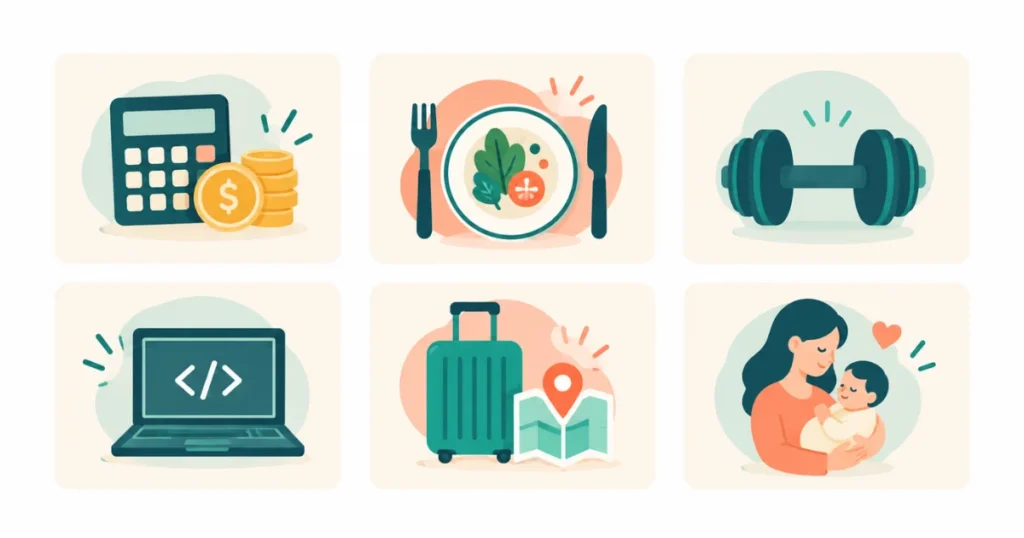
Not every niche is equal. Some have structural advantages — they attract readers who are ready to spend money, or they have consistent year-round search demand, or they compound well over time.
Here are niches that have proven track records for beginner bloggers willing to put in real work:
Personal finance — budgeting, saving, investing basics, debt payoff. High search volume, excellent affiliate programs (financial tools, courses, apps), good AdSense rates. Competitive, but very workable if you pick a specific angle (e.g. personal finance for NHS workers, or debt payoff on a low income).
Health and fitness — specific fitness goals, workout plans, nutrition for a particular lifestyle. Strong evergreen demand. Note: Google applies higher quality standards here, so personal experience and clear sourcing matter more than in most niches.
Productivity and tools — software comparisons, workflow systems, time management for specific types of workers. Strong affiliate potential with SaaS products (which often pay 20–40% recurring commissions). Great for people who genuinely use and test tools.
Parenting — age-specific, challenge-specific, or lifestyle-specific parenting content. Deeply personal, builds strong reader loyalty, steady search demand.
Food and recipes — works best with a specific angle (budget cooking, one-pan meals, a specific dietary approach). Highly visual, shares well on Pinterest, good AdSense revenue.
Making money online / blogging itself — this one is competitive and tricky for pure beginners because E-E-A-T requirements are high. Readers want to know you’ve actually done it. Best approached once you have some results to share.
The pattern across all of these: the bloggers who succeed aren’t the ones who picked the “best” niche on paper. They’re the ones who stuck with a reasonable niche long enough for it to work.
How Narrow Should Your Niche Be?
This is the question that ties most beginners in knots.
The short answer: narrower than you think at first, broader than you’re afraid it needs to be.
“Personal finance” is too broad to compete in as a new blog. “Personal finance for teachers in their first five years of work” might be narrow enough to build real authority quickly, then expand from there.
“Food blog” is too broad. “Quick weeknight dinners for families with kids under ten” is specific enough to attract a defined reader and rank for specific searches.
Think of it this way: you want to be the obvious choice for a specific person, not a vague option for everyone. Once you’ve established authority in a narrower space, expanding into adjacent territory is much easier — and you’ll have a foundation of content and rankings to build from.
Mistakes Beginners Make When Choosing a Niche

Choosing based purely on profit potential. Looking at a list of “highest RPM niches” and picking finance or tech even though you have no real interest or knowledge in either. You’ll either quit in month two or produce thin, forgettable content that doesn’t rank.
Picking something so narrow there’s no audience. “Knitting for left-handed accountants over 60 in rural Scotland” is a real person’s passion but not a viable blog niche. Check that the audience actually exists at searchable scale before you commit.
Treating niche selection as an irreversible decision. It isn’t. Plenty of successful bloggers pivoted their niche in year one or two. The work you do in an early niche — building writing habits, learning SEO, understanding your reader — transfers. Don’t let the fear of “wrong choice” stop you from making any choice.
Starting too broad to avoid missing anything. A general lifestyle blog that covers travel, food, fashion, and parenting sounds appealing because you write about what you want. In practice, Google doesn’t know what it is, readers don’t know what to expect, and you compete in every niche simultaneously without authority in any.
Skipping the demand check entirely. Writing posts you love about a topic nobody searches for is personally fulfilling but won’t build an audience on its own. Check the demand first, then write the posts you love within it.
Pick Something and Start

The bloggers who do well aren’t the ones who found the perfect niche. They’re the ones who picked a reasonable one, published consistently, and kept going when it was quiet.
Your niche will evolve. Your understanding of your reader will sharpen. Posts you thought were your best might underperform, and ones you dashed off quickly might rank for months. None of that is predictable at the start.
What you need is a defensible answer to three questions:
- Do I know enough about this to write genuinely useful content?
- Are real people searching for this kind of content?
- Can I see myself writing in this space for at least a year?
If the answer to all three is yes — or even a confident “probably” — that’s enough. Start there.
Once you’ve chosen your niche, the next step is setting up your blog properly from day one. Here’s how to start a blog and actually make money from it →
And if you want a quick sense of what your chosen niche could realistically earn, the Blog Income Calculator gives you a grounded estimate based on your niche, traffic, and monetization approach.
Frequently Asked Questions
Q1: How do I choose a blog niche if I have too many interests?
Make a short list of your top three to five interests, then run a basic search demand check on each one using Google autocomplete or a free keyword tool. The one with the most searchable questions and the most specific audience angle becomes your starting niche. You can always expand later — the priority at the start is picking one and building depth in it.
Q2: Can I change my blog niche after I’ve started?
Yes. Many successful bloggers pivot their niche in their first one to two years. The work you do while finding your direction — writing, learning SEO, understanding how blogs work — doesn’t disappear when you shift focus. That said, a pivot is easier before you have hundreds of posts in a different direction, so don’t delay indefinitely on the basis that you can always change later.
Q3: Do I need to be an expert to blog in a niche?
No — but you need to add genuine value. That can come from personal experience, from learning in public and documenting your journey, from curating and synthesising information better than what’s already out there, or from a specific angle or perspective your audience can’t find elsewhere. Google’s quality standards have risen, so thin content with no original perspective performs poorly regardless of the niche.
Q4: What are the most profitable blog niches in 2026?
Niches with consistently high earning potential include personal finance, health and wellness, software and tech tools, online business, and parenting. These earn well because they attract audiences with buying intent and have strong affiliate programs and ad rates. That said, a focused blog in a less “profitable” niche often outperforms a surface-level blog in a competitive one. Execution matters more than niche selection alone.
Q5: Is a broad niche or a narrow niche better for beginners?
A narrower niche is almost always better for beginners. A specific topic helps you build topical authority faster, rank for more achievable keywords, and attract a clearly defined audience. Once you have established content and traffic in a narrower space, expanding into adjacent territory becomes much easier and less risky.
Q6: How do I know if there’s enough search demand for my niche?
Use Google’s autocomplete to check whether people are searching in your topic area. Then verify with a free keyword tool like Ubersuggest or Google Keyword Planner — look for consistent monthly search volume across the kinds of questions you’d want to answer. You don’t need millions of monthly searches. A niche with steady demand across dozens of searchable questions is workable.
Q7: Can I blog about something I’m not passionate about if it’s profitable?
Some people do — and succeed. But most beginners underestimate how much consistency blogging requires. If a topic actively bores you, producing genuinely useful content week after week becomes grinding. A topic you find interesting but not life-defining is usually fine. A topic that actively drains you is a risk to your ability to keep going.
Q8: How many posts should I write before I know if my niche is working?
Give it at least 20 to 30 well-researched, properly optimised posts before drawing conclusions about whether the niche is viable. SEO takes time — most posts don’t reach their peak traffic for 6 to 12 months after publication. Judging a niche on your first five posts is like judging a restaurant on the first week of its soft launch.
Q9: Should I choose a niche based on what I know or what I want to learn?
Either works — but they require different approaches. If you’re blogging about something you know well, your first-hand experience is your main advantage and you should lean into it. If you’re blogging about something you’re learning, document the journey honestly. “I tried X and here’s what happened” is genuinely valuable content, as long as you’re not presenting learning-in-progress as established expertise.
Q10: What’s the difference between a niche and a sub-niche?
A niche is a broad topic area (personal finance, fitness, food). A sub-niche is a specific angle within that area (personal finance for new graduates, postpartum fitness, budget meal prep for families). For beginners, starting at the sub-niche level gives you a more realistic path to ranking and building an engaged audience before expanding upward.