The first digital product I ever made sat on Gumroad for three months with exactly four sales.
Two of them were from my sister.
I’d spent hours designing it, writing the description, setting up the shop. And then I just… waited. Because that’s what nobody tells you — creating the product is maybe 20% of the work. The other 80% is getting it in front of people who actually want it.
But here’s the thing I kept running into: everyone talking about “marketing” seemed to assume you had money to spend on ads. Facebook ads. Instagram ads. Pinterest promoted pins. Google Shopping.
I had none of that. I had a product, a laptop, and a lot of free time I was willing to trade for results.
So I figured it out the hard way. And honestly? The free strategies ended up being more sustainable than any ad I’ve seen creators run.
Here’s what actually worked to sell digital products without paid ads.
First, a Mindset Shift Worth Making
Paid ads give you speed. Free marketing gives you compounding results.
When you run an ad, the moment you stop paying, the traffic stops. But when you write a blog post that ranks, pin something that gets repinned 800 times, or build an email list of 500 people — those things keep working for you long after you did the work.
It’s slower. I won’t lie to you. But it’s real.
Now let’s get into it.
Strategy 1: Build a Blog That Works for You 24/7
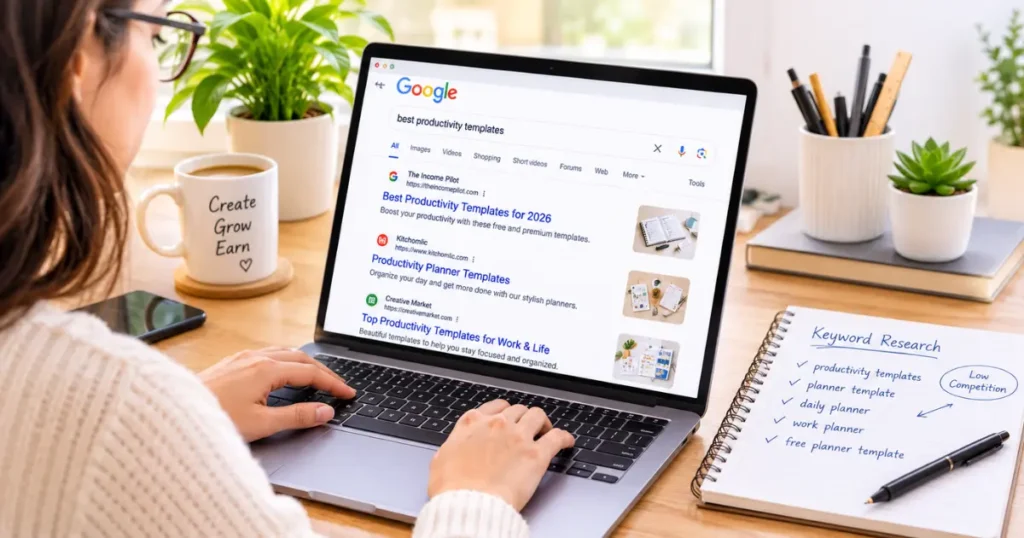
If you have a blog — or you’re willing to start one — this is the single highest-leverage thing you can do for long-term free traffic.
Here’s why it works so well for digital product creators: people search for things like “best Notion templates for students” or “how to plan a wedding on a budget” or “social media templates for small businesses.” Those are buyer-intent searches. And if you’ve created a product that solves exactly that problem, a well-written post can send warm, ready-to-buy traffic directly to your shop.
My process looks like this:
- Pick a keyword your buyer actually searches — not “digital products,” something specific like “social media content calendar template free”
- Write a post that genuinely helps them — tutorials, comparisons, or “best of” roundups work well
- Mention your product naturally — don’t cram it in, let it fit the conversation
- Link to your product page or Etsy listing
It takes 3–6 months to see real traction from blog SEO, but once it starts, it runs on its own.
If you’re new to getting blog traffic without paying for it, I have a full breakdown in How to Drive Traffic to Your Blog (Without Paid Ads) — it covers everything from keyword research to getting indexed faster.
And if you haven’t figured out the SEO side yet, Blog SEO for Beginners: How to Rank Your Posts walks you through it step by step without the overwhelm.
Strategy 2: Pinterest — Seriously, Don’t Sleep on This
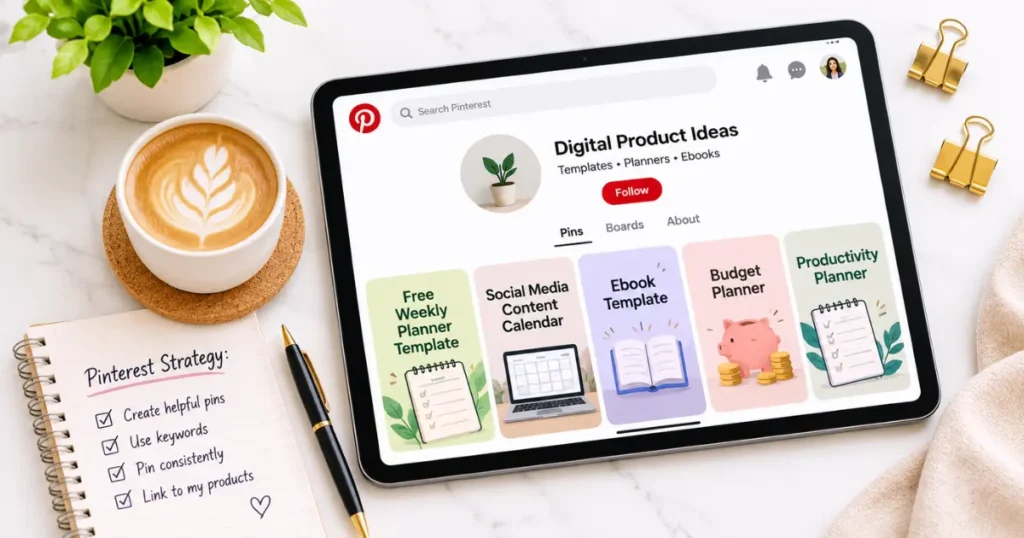
Pinterest is not social media. I mean, it kind of is, but for our purposes it’s a visual search engine — and that changes everything.
When someone pins your product image on Pinterest, that pin can live there for years and keep driving traffic. Compare that to Instagram, where a post dies in 48 hours.
For digital products especially — planners, templates, ebooks, printables, Canva designs — Pinterest is genuinely one of the best free channels you can use.
Here’s my simple Pinterest setup:
Step 1: Create a Pinterest business account (free) Step 2: Set up 5–8 boards relevant to your niche (e.g., “Small Business Templates,” “Notion Productivity,” “Budget Planners”) Step 3: Design vertical pins using Canva — 1000x1500px works well. Make them text-forward with a clear value statement (“Free Weekly Planner Template” or “Social Media Content Calendar — $7”) Step 4: Pin consistently — 3 to 5 times a day if you can. Use Tailwind (there’s a free plan) to schedule in batches Step 5: Link each pin directly to your product or to a blog post that links to your product
The key is your pin image. Make it look like something someone would actually save, not like a generic ad. Think “helpful infographic” vibes, not “buy my stuff” vibes.
I’ve seen creators get thousands of monthly views from Pinterest alone, driving consistent traffic to Etsy shops and Gumroad pages without spending a cent.
Strategy 3: Build Your Email List from Day One

I put this off for way too long. Huge mistake.
Your email list is the one audience you actually own. Instagram can change its algorithm. Etsy can change its search. Pinterest can throttle organic reach. But your email list? That’s yours.
Here’s how I’d start if I were doing it over:
Create a free lead magnet — a mini version or companion to your paid product. If you sell a full social media template pack, offer one free template in exchange for an email. If you sell an ebook, offer the first chapter or a related checklist.
Use a free email tool — Mailchimp (free up to 500 contacts) or Kit (formerly ConvertKit, free plan available) are both solid starting points.
Add a signup form everywhere — your blog, your Gumroad/Etsy shop description (link to a landing page), your Pinterest bio, your Instagram bio.
Send value-first emails — don’t just sell. Share tips, behind-the-scenes content, quick wins. Then, when you launch a new product or run a sale, you have a warm audience ready to hear about it.
Even a list of 200 engaged subscribers can drive meaningful sales. It’s not about the number — it’s about the trust you’ve built.
Strategy 4: Show Up in Online Communities (The Right Way)
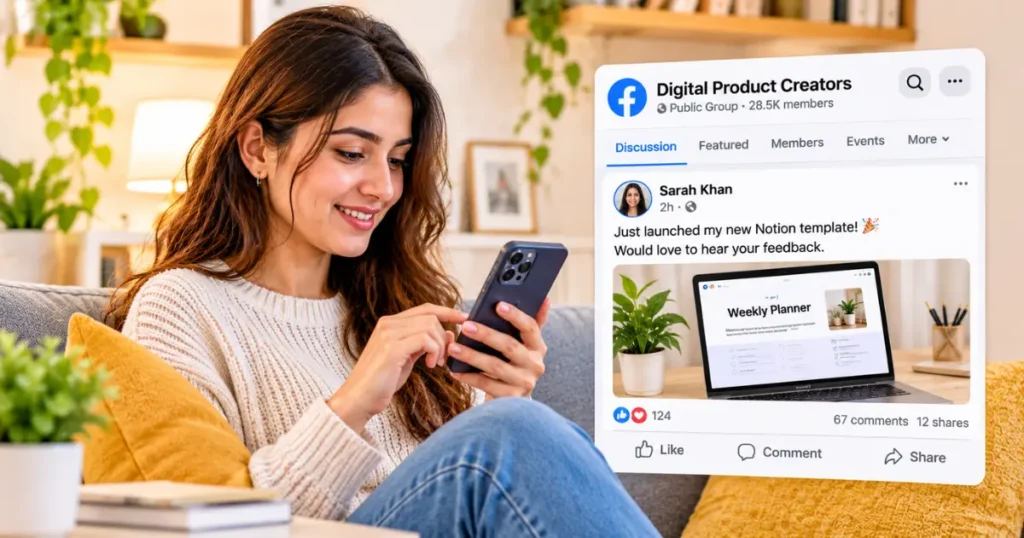
Facebook groups, Reddit communities, Discord servers, niche forums — these are full of your exact buyers having conversations every day.
The mistake most people make is joining and immediately posting “Hey, check out my product!” That gets you ignored (or banned).
The right way is to be genuinely helpful first.
Spend a few weeks answering questions, sharing tips, being a real member of the community. Build recognition. Then when it’s appropriate — and when the group rules allow — you can mention what you offer. Or people will just ask you directly because you’ve built trust.
Some specific communities worth exploring depending on your niche:
- Facebook groups for bloggers, small business owners, teachers, Etsy sellers
- Reddit: r/Etsy, r/passive_income, r/Entrepreneur, r/digitalnomad
- Discord servers in your niche (search for them on Disboard.org)
One authentic comment in the right thread can drive more traffic than a week of posting to an empty Instagram page.
Strategy 5: Optimize Your Product Listings for Search
This is the one people overlook most — and it’s completely free.
Whether you’re on Etsy, Gumroad, Payhip, or your own site, your product page itself needs to be optimized so people can find it organically.
On Etsy, that means:
- Using all 13 tags with real search terms buyers use
- Front-loading your title with the most specific keyword
- Writing a description that answers “what is this, who is it for, and what will it help me do?”
On your own site or Gumroad, it means:
- Writing a product page that reads naturally but includes the terms your buyer would search
- Getting backlinks by sharing it in blog posts and having other creators mention it
This is essentially free SEO, and it’s the reason some Etsy sellers get thousands of visits without ever running a single promoted listing.
I’ve already got a post that goes really deep on this — Etsy SEO Tips for Digital Products That Rank Fast covers the specific tactics that work right now, including title structure and tag research.
Strategy 6: Leverage Other People’s Audiences
You don’t need a big audience. You need access to someone who already has one.
Some ideas that don’t cost money:
Guest posting — write a helpful article for a blog in your niche and mention your product naturally within it.
Collaborations — partner with another digital product creator at a similar level. Cross-promote to each other’s lists or audiences.
Podcast appearances — pitch yourself to small-to-mid podcasts in your niche. You’d be surprised how many hosts are actively looking for guests. Even a podcast with 500 listeners can send genuinely interested buyers your way.
YouTube mentions — if someone creates content in your niche, reach out and offer a free copy of your product for an honest mention or review.
The goal is to borrow trust. When someone recommends you to their audience, it carries weight that a random ad never will.
Strategy 7: Content on Short-Form Video (Without Dancing)
Look, TikTok and Instagram Reels feel intimidating. But you don’t have to do trending audio or dance challenges to make them work.
What actually performs well for digital product creators is “process content” and “result content”:
- Process: “Watch me create this Notion dashboard in 10 minutes”
- Result: “The template that helped me go from chaotic to organized”
- Tutorial: “Here’s how I use this budget tracker every week”
These videos build trust, demonstrate value, and drive people to your profile link — which should go to your product or a landing page.
You don’t need fancy equipment. Your phone is enough. And you only need to post 3–4 times a week to see results. Consistency beats volume.
If you’re using AI tools to create your content more efficiently, you might also like my post on Using AI to Create and Sell Digital Products — it shows how to use tools like ChatGPT and Canva AI to cut your content creation time in half.
Mistakes I Made (So You Don’t Have To)
Trying to be everywhere at once. I spread myself across Pinterest, Instagram, TikTok, a blog, Twitter, and a Facebook group simultaneously. I was burned out within a month and doing all of them badly. Pick two channels. Do them well. Expand later.
Posting without a link. I’d create content and forget to include a direct link to my product. Always make it easy for people to find what you’re selling.
Giving up after two weeks. Organic marketing takes time. Most people quit right before it starts working. Commit to 90 days before you judge any channel.
Only marketing when I had a new product. Marketing is a consistent activity, not a launch event. Even when you’re not releasing anything new, you should be showing up somewhere.
What to Focus on First
If you’re just starting out and feeling overwhelmed, here’s the order I’d recommend:
- Optimize your product listing — make sure it’s findable before you drive traffic to it
- Start building your email list — even if it’s just 20 people, start now
- Pick one traffic channel (blog or Pinterest if you prefer writing; TikTok/Reels if you prefer video)
- Show up in one community — be helpful, build relationships
- Add more channels once the first one is working
For the bigger picture — how all of this fits into actually building recurring income from digital products — check out How to Build Passive Income with Digital Products. That post covers the full ecosystem, not just the marketing piece.

Marketing your digital products without ads is completely doable. It just requires patience and showing up consistently in places your buyers already are.
The creators I’ve watched succeed long-term aren’t always the ones who had the best products. They’re the ones who kept showing up, kept being helpful, and kept making it easy for the right people to find them.
That’s the whole game.
Frequently Asked Questions
1. Can you really sell digital products without running any ads?
Yes — and many successful sellers never run ads at all. SEO, Pinterest, email lists, and organic social can build a steady stream of buyers. It takes longer than paid ads, but the traffic is often higher quality and costs nothing to maintain.
2. What’s the fastest free way to start getting traffic to a digital product?
Listing optimization (Etsy SEO or product page SEO) is the fastest because it captures people already searching to buy. Pair that with Pinterest for visual products, and you can see movement within a few weeks.
3. Does Pinterest actually work for selling digital products?
Yes — especially for visual products like templates, planners, printables, and ebooks. Pinterest is a search engine, so well-designed pins can drive traffic for months or years after you create them.
4. How long does organic marketing take to work?
Realistically, give yourself 60–90 days before judging a channel. SEO can take 3–6 months to build momentum. Pinterest and email show earlier results. The key is consistency, not intensity.
5. Do I need a big following to sell digital products?
No. Plenty of creators make consistent sales with under 500 followers. What matters is reaching the right people, not the most people. A niche audience of 200 genuine fans will outperform 10,000 random followers every time.
6. What’s the best platform to sell digital products without needing traffic of my own?
Etsy is the most beginner-friendly because it has built-in search traffic. If you optimize your listings well, you don’t need an audience to start making sales. Check my post on the Best Platforms to Sell Digital Products for a full comparison.
7. How do I grow an email list when I have no audience?
Offer a free lead magnet — a useful freebie related to your paid product. Promote it through your product listing bio, Pinterest profile, and any communities you’re active in. Even 10 subscribers is a start. Grow from there.
8. Should I focus on Instagram or Pinterest for digital products?
For most digital product categories, Pinterest outperforms Instagram because content has a longer shelf life and the platform is built around search. Instagram is better if your audience is very engaged and community-driven. If you can only pick one, start with Pinterest.
9. Can I use AI tools to help with organic marketing?
Absolutely. AI tools like ChatGPT can help you write Pinterest descriptions, draft email sequences, brainstorm blog post topics, and create product listing copy faster. I’ve written more about this in Using AI to Create and Sell Digital Products.
10. What’s one thing I should do today if I’ve never marketed a digital product before?
Go back to your product listing and rewrite it with the buyer in mind — lead with the outcome, not a description of features. Then make sure your title includes the exact phrase someone would type into a search bar to find it. That one change alone can shift your results.